Africa contains some of the world's greatest natural wealth: the Sahara and Sahel, the Congo Basin, the Nile, the Great Rift Valley, the savannas of East Africa, vast wetlands, tropical forests, mountains, fertile agricultural regions and thousands of kilometers of coastline.
It is also home to communities whose lives remain closely connected to rainfall, soil, forests, rivers, livestock and small-scale agriculture. That relationship makes much of Africa particularly vulnerable when the climate changes.
Across different parts of the continent, communities are confronting combinations of rising temperatures · prolonged drought · unpredictable rainfall · catastrophic floods · desertification · land degradation · crop failures · livestock losses · disease outbreaks · displacement · conflict · hunger.
These problems are interconnected. Drought can destroy crops. Crop failure can increase hunger. Scarcity of pasture and water can intensify competition. Conflict can prevent farmers from planting. Displaced populations may lack clean water and sanitation. Flooding can then contaminate water supplies and spread disease.
Yet Africa is also producing some of the world's most interesting examples of community-led environmental restoration.
One of the most important lessons is remarkably simple:
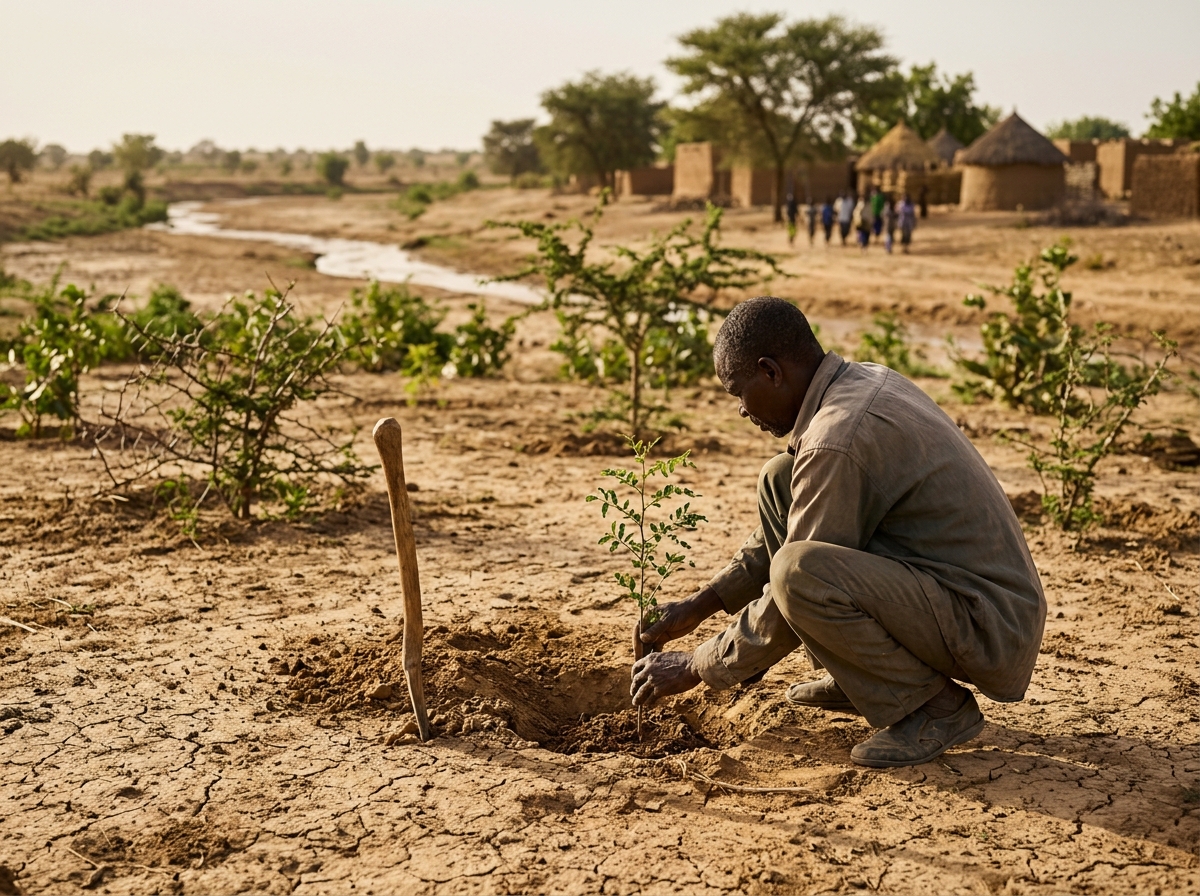
Restoring Africa does not always begin with billion-dollar projects. Sometimes it begins with one farmer protecting one tree.
Africa Did Not Create the Climate Crisis Alone
Africa's vulnerability is particularly important because many African countries have contributed relatively little historically to the greenhouse-gas emissions driving global warming. Yet the continent faces substantial consequences.
WHO has emphasized that Africa bears severe health impacts from climate change even though its contribution to global warming has been comparatively small. Climate-sensitive effects already include floods, heat, malnutrition and changes in water- and vector-borne diseases. *(WHO Regional Office for Africa)*
This makes climate change not only an environmental problem but also an issue of development, poverty and global equity.
There Is No Single African Climate
It is important not to speak about Africa as though the entire continent has the same climate. Africa contains Mediterranean climates · tropical rainforests · deserts · semi-arid grasslands · savannas · highland climates · coastal regions · wetlands.
Climate change therefore affects different regions differently. Some places face increasing drought. Others experience extreme rainfall. Some may experience both.
The Sahel: Living on the Edge of Rainfall
The Sahel stretches across Africa south of the Sahara. It includes parts of countries such as Senegal, Mauritania, Mali, Burkina Faso, Niger, Nigeria, Chad and Sudan.
Agriculture and livestock production in many areas depend heavily on seasonal rainfall. When rainfall fails, consequences can be immediate.
Drought: When the Rain Does Not Come
Imagine a farming village waiting for the rainy season. The farmer prepares the soil. Seeds are planted. The family waits. Some rain arrives. The seeds germinate. Then the rain stops. The young plants die.
The farmer may have lost seed + labor + money + food for the coming year.
For families living close to subsistence level, one failed rainy season can become a crisis. Several failed seasons can become a disaster.
The Horn of Africa
Countries in the greater Horn of Africa — including Somalia, Ethiopia, Kenya, Djibouti, Sudan, South Sudan and Uganda — have experienced severe climate shocks.
During the major drought crisis earlier this decade, WHO reported multiple consecutive failed rainy seasons, widespread hunger, displacement and simultaneous outbreaks of infectious diseases.
And the problem has not disappeared. As of August 2026, Somalia is again experiencing an extremely serious food-security crisis. Around six million people are facing acute food insecurity, with drought, conflict and displacement among the contributing factors. *(AP News)*
This demonstrates how environmental and political crises can compound one another.
Drought Kills Livestock Too
In pastoral communities, livestock can represent food · milk · income · savings · transportation · social status · family security.
When drought destroys pasture and watering points, animals weaken. Families may be forced to sell livestock at extremely low prices. If the animals die, the family's accumulated wealth may disappear.
Then the Rain Can Become Too Much
One of the cruel paradoxes of climate variability is that drought can be followed by destructive rainfall.
Dry, degraded soil may absorb water poorly. When intense rain finally arrives, water rushes across the surface. Instead of soaking into the ground, it can wash away topsoil · destroy roads · flood villages · damage crops · contaminate wells · destroy homes.
The water desperately needed during the drought can disappear downstream within hours.
Africa Faces Both Drought and Flood
This is a central lesson. The challenge is not simply *"How do we get more rain?"* It is *"How do we manage the rain when it arrives?"*
The goal should increasingly become: Slow it. Spread it. Store it. Allow it to enter the soil.
Floods Can Destroy Entire Agricultural Seasons
Extreme rainfall can submerge crops · kill livestock · erode farmland · destroy stored grain · damage irrigation systems · wash away seeds · destroy roads and bridges.
Farmers may survive the immediate flood but lose the food and income needed for the following year.
Flooding Can Also Trigger Disease
Floodwater can mix with sewage · animal waste · garbage · contaminated water. Damaged sanitation systems can create conditions favorable to waterborne disease.
WHO reported that in the first six weeks of 2026, cholera cases in Southern Africa were more than seven times the number recorded during the same period of 2025, amid severe flooding, cyclones, infrastructure damage and displacement.
Climate change does not "cause" every disease outbreak directly. Instead, it can create conditions that make outbreaks more likely or more difficult to control.
Cholera: A Disease Closely Connected to Water
Cholera spreads primarily through contaminated food and water. It is largely preventable when communities have reliable clean drinking water · sanitation · hygiene.
But floods can contaminate water supplies. Drought can force people to use unsafe water. Conflict can destroy sanitation infrastructure. Displacement camps can become overcrowded.
WHO notes that climate extremes — including floods, cyclones and drought — are now compounding the conditions that contribute to cholera outbreaks. *(World Health Organization)*
Malaria and a Changing Climate
Malaria remains one of Africa's major public-health challenges. Temperature, rainfall and humidity influence mosquito survival and reproduction. Changing climatic conditions can alter mosquito breeding · transmission seasons · geographic ranges.
WHO identifies malaria and other vector-borne diseases among the major health concerns associated with climate change in Africa.
But climate is only one factor. Disease risk is also shaped by healthcare access · mosquito control · housing · poverty · bed-net use · medicines · public-health systems.
Climate Change + Poverty = Greater Vulnerability
A wealthy community experiencing drought may have reservoirs · irrigation · crop insurance · food imports · emergency funds. A poor rural community may have none of these.
The same climate event therefore produces very different consequences. This is why climate resilience must include poverty reduction.
Climate Change + Conflict
The relationship between climate change and war must be described carefully. Climate change does not automatically cause wars. Wars result from complicated combinations of politics · governance · history · ethnicity · economics · inequality · armed groups · international involvement.
But environmental stress can become an additional pressure.
Water and Pasture Competition
Consider two communities. One primarily farms. Another depends on livestock.
During normal rainfall there may be enough water + grass + agricultural land for both.
During severe drought: pasture disappears · herders must move farther · livestock may enter agricultural land · crops can be damaged · competition over wells increases · existing tensions can intensify.
Climate change can therefore act as a threat multiplier. It adds stress to already fragile situations.
War Makes Climate Adaptation Harder
The relationship works in both directions. Climate stress can aggravate instability. But conflict also makes communities less capable of surviving climate shocks.
War can prevent farmers from planting · harvesting · reaching markets · accessing wells · moving livestock safely. Conflict can destroy irrigation · roads · hospitals · schools · water systems. Farmers may abandon land entirely.
Hunger Is Usually More Complicated Than "Not Enough Food"
Food insecurity can result from combinations of drought · crop failure · conflict · displacement · high food prices · poverty · transportation disruption.
A country may contain food while some people cannot afford or safely reach it. Solving hunger therefore requires more than simply increasing crop production.
The Village Can Become the Center of the Solution
Global climate negotiations matter. National policies matter. Large infrastructure projects matter.
But thousands of African communities cannot wait for every global problem to be solved. There are interventions that can begin at village level. And many are surprisingly simple.
Start With the Tree
Trees are among the most powerful environmental tools available to rural communities. A tree can provide shade · fruit · fodder · fuelwood · timber · wildlife habitat · wind protection. Its roots can stabilize soil · reduce erosion · improve soil structure. Trees can also store carbon.
But there is an important lesson: reforestation is not simply planting millions of seedlings. Planting is easy. Keeping trees alive is harder.
Niger Provides an Extraordinary Example
One of Africa's most important restoration stories has occurred in Niger.
Instead of relying entirely on planting new trees, farmers began protecting and managing trees and shrubs that naturally regenerated from existing roots and stumps.
This approach became known as Farmer Managed Natural Regeneration — FMNR.
Farmers identify useful shoots. They protect them. They prune them. They allow selected stems to become trees.
The result can be much cheaper and more successful than planting seedlings where mature underground root systems already exist.
Millions of Hectares Regenerated
Research summarized by the U.S. Geological Survey estimated that by 2017, roughly 7 million hectares in Niger had been affected by farmer-managed natural regeneration.
Sparse agricultural landscapes visible in the 1970s were transformed in many areas into much denser agroforestry parklands. *(USGS)*
This is important because much of the transformation was driven by farmers themselves.
Why FMNR Can Work
A landscape that appears treeless may contain an underground forest. Old tree roots can remain alive beneath the soil.
Instead of planting *seedling → water → protect → hope it survives*, a farmer may protect *existing root → natural shoot → prune → tree.*
Established roots can provide access to deeper moisture and stored energy. That can make regeneration much more resilient in dry environments.
Give the Farmer Ownership
Niger's experience also demonstrates the importance of policy. When farmers have rights to the trees growing on their land, they have an incentive to protect them.
USGS notes that changes in Niger's tree-ownership rules helped create conditions supporting farmer-managed restoration.
This illustrates an important principle: people protect resources when protecting them also benefits their families.
One Farmer Can Start
Imagine one farmer protects 10 trees. His neighbor sees better shade · less wind · improved soil · more fodder. The neighbor protects 20. Then another family participates.
Soon 10 farmers become 100 farmers, and one village becomes 100 villages.
Landscape restoration does not always require bulldozers and massive infrastructure. Sometimes it spreads from farmer to farmer.
One Village Can Plant and Protect Thousands of Trees
Suppose a village contains 500 households. If every household successfully establishes or regenerates 10 trees per year, the village could add 5,000 trees annually.
Over ten years, that represents a potential 50,000 tree-establishment events — though survival, thinning, land availability and ecological suitability mean the eventual mature-tree count would differ.
Now imagine thousands of villages participating. That is the scale at which individual action becomes landscape change.
But Plant the Right Trees
A global tree-planting campaign should never simply say *"plant any tree anywhere."* The wrong tree can consume scarce water · become invasive · damage local ecosystems · provide little benefit to wildlife.
Prioritize locally appropriate species, especially native trees and useful agroforestry species suited to rainfall · soil · elevation · farming system.
Fruit Trees Can Fight Hunger
Where ecologically appropriate, villages can prioritize useful trees such as locally suitable mango, citrus, guava, papaya, tamarind, baobab, moringa, date palm and indigenous fruits depending on region.
A tree can become both climate infrastructure and food infrastructure.
Agroforestry: Don't Separate Trees and Agriculture
In many landscapes the best approach may not be *forest OR farm.* It can be trees + crops + livestock.
Agroforestry can provide shade · fodder · fruit · fuelwood · windbreaks · soil protection · habitat while allowing agricultural production to continue.
The Great Green Wall
Africa's Great Green Wall began with the broad vision of combating desertification across the Sahel. The concept has evolved beyond the idea of one continuous line of trees. It increasingly emphasizes a mosaic of restored productive landscapes.
The initiative spans countries from Senegal toward the Horn of Africa and seeks to restore degraded land while supporting livelihoods and food security. *(FAO)*
That distinction matters. Africa does not need a decorative line of trees. It needs productive land + healthy soil + water + vegetation + livelihoods.
Villages in Niger Are Showing How
FAO documented restoration efforts around villages in Niger where communities were trained to plant and seed vegetation · manage natural resources · construct semicircular "half-moons" in the soil · capture rainfall · restore degraded land.
One community effort mobilized more than 1,500 people in restoration activities.
This is the kind of local action worth expanding.
Capture Every Drop of Rain
In dry areas, rain should not simply rush away. Villages can use locally appropriate techniques such as contour bunds · terraces · small check dams · farm ponds · swales · half-moons · zai pits · rooftop rainwater collection.
The objective is:
*rain falls → slow the water → allow infiltration → recharge soil → grow vegetation → protect soil → capture more rain next time.*
This can create a positive ecological cycle.
Zai Pits
Traditional zai techniques used in parts of the Sahel involve digging small planting pits. Organic material can be added. Rainwater concentrates in the pit. Seeds are planted where moisture and nutrients are available.
Such methods can help rehabilitate degraded dryland soils when used appropriately. Traditional agricultural knowledge can therefore become part of modern climate adaptation.
Stop Soil From Leaving the Village
When vegetation disappears, wind and rain remove fertile topsoil. The village becomes progressively less productive.
Restoration should therefore focus on ground cover · trees · grasses · mulching · contour barriers · reduced erosion.
The goal is simple: keep the soil where the food needs to grow.
Protect Village Water
Every village can map wells · springs · streams · ponds · wetlands · seasonal rivers. Then monitor water level · water quality · seasonal availability · pollution.
This creates local water intelligence.
Clean Water Is Climate Adaptation
A village can plant thousands of trees and still suffer terribly if drinking water is contaminated.
Climate resilience must include safe wells · protected water sources · sanitation · handwashing · water treatment · drainage. This is also disease prevention.
Village Seed Banks
Climate variability makes agricultural diversity increasingly important. Communities can preserve seeds adapted to drought · heat · short growing seasons · local pests.
Village seed banks can preserve traditional varieties that might otherwise disappear.
Don't Depend on One Crop
If every farmer grows the same crop and that crop fails, the entire village becomes vulnerable. Diversification might include locally appropriate combinations of millet, sorghum, cowpea, cassava, maize, vegetables, fruit, livestock, agroforestry. Different regions require different solutions.
Solar Power Can Transform Rural Resilience
Many African regions have extraordinary solar resources. Village-scale solar can power water pumps · refrigeration · clinics · schools · communications · food processing.
Solar-powered cold storage can be particularly valuable. A farmer's harvest has little value if it spoils before reaching market.
Reduce Food Loss
Solving hunger is not only about producing more food. Food can be lost after harvest because of heat · insects · mold · poor storage · lack of refrigeration · transportation problems.
Improved drying + storage + refrigeration + processing + transportation can effectively create more available food without expanding farmland.
Restore Land and Create Employment
Environmental restoration can become economic development. Young people can work in nurseries · agroforestry · water conservation · solar installation · irrigation · composting · food processing · beekeeping · ecotourism · environmental monitoring.
The objective should not be *"protect nature instead of earning a living."* It should be restore nature while creating livelihoods.
Women Must Be Central to the Solution
In many rural African communities, women play major roles in farming · water collection · food preparation · childcare · markets · fuelwood collection.
Environmental degradation can increase their workload dramatically. If a water source dries, someone walks farther. If fuelwood disappears, someone searches farther. If crops fail, someone must find another way to feed the family.
Climate programs designed without women's participation will miss essential knowledge and needs.
Schools Can Become Nature Restoration Centers
Imagine every village school maintaining a Nature & Climate Garden. Students could grow native trees · fruit trees · vegetables · pollinator plants.
Children could learn tree identification · rainfall measurement · soil conservation · composting · water conservation · climate science.
Each student could adopt a tree.
Adopt a Tree
A simple village program could say:
One Child · One Tree · One Lifetime
But the important measurement should not be *"How many seedlings did we distribute?"* It should be "How many trees are alive five years later?"
Survival matters more than planting ceremonies.
NaturePulse Could Help Document This Transformation
This is where NaturePulse could have a particularly meaningful African mission.
NaturePulse could allow every village to establish a Village Nature & Climate Page.
*Example: Village · Country · GPS · Population.*
Then document:
- Trees — trees planted, regenerated and surviving.
- Agriculture — crops, planting dates, harvests and failures.
- Rain — rainfall observations.
- Water — wells, ponds and river levels.
- Drought — dry conditions and crop impacts.
- Floods — flood extent and damage.
- Wildlife — birds, animals and insects.
- Health & Environment — non-private community-level environmental observations.
Photograph the Same Land Every Year
This could become extraordinarily valuable. A villager stands at the same GPS point.
*2027 — Bare degraded land.*
*2029 — Small shrubs.*
*2032 — Young trees.*
*2037 — Agroforestry.*
*2047 — A mature productive landscape.*
NaturePulse could display BEFORE ↔ AFTER and preserve the transformation permanently.
Record Every Tree Restoration Project
Each project could contain GPS · species · planting or regeneration method · date · individual/family/village · photograph · survival status. Then revisit 6 months · 1 year · 5 years · 10 years later.
This converts *"we planted 10,000 trees"* into something much more meaningful: "7,200 of our trees are still alive after five years."
A Village Climate Dashboard
Eventually NaturePulse could show:
- 🌳 Trees restored — 14,280
- 🌧 Rainfall this season — recorded locally
- 💧 Wells — 18 monitored
- 🌾 Crops — 12 varieties documented
- 🐦 Bird species — 74 observed
- 🦋 Pollinators — 31 documented
- 🔥 Fires — 2 recorded
- 🌊 Flood events — 3 recorded
The village begins building its own environmental history.
Village vs. Village — Friendly Restoration Challenges
NaturePulse could make restoration engaging: 🌳 most trees surviving · 💧 most water conserved · 🌾 greatest crop diversity · 🦋 most pollinator species · 🐦 most bird species recorded · ♻️ cleanest village campaign · 🌱 most degraded land restored.
Recognition can motivate participation without turning conservation into competition over unreliable numbers; observations should be verifiable and survival should matter more than raw planting totals.
Connect African Villages With the World
Imagine someone in Oregon sponsoring a village tree-restoration program in Niger. They could open NaturePulse and see:
*Tree #NGR-001827 · Species: local native · Planted/Regenerated: June 2028 · GPS: village location.*
*2028 — Young shoot. · 2029 — Growing. · 2032 — Established.*
The supporter does not merely receive a certificate. They can see the restoration develop.
Researchers Could Learn From the Data
With appropriate privacy protections, verification and open-data rules, aggregated NaturePulse observations could eventually support universities · agricultural researchers · NGOs · governments · climate scientists · conservation organizations · humanitarian organizations.
A village should also benefit from the information it creates. Environmental data should not simply flow outward. Useful knowledge should flow back to the community.
Africa's Future Is Not Only a Story of Crisis
Discussions about Africa and climate change can become overwhelmingly negative. Drought. War. Disease. Hunger. Poverty. Those problems are real.
But they are not the complete story.
There is another African story:
- Farmers regenerating trees.
- Villages restoring degraded soil.
- Communities harvesting rainwater.
- Women organizing agricultural cooperatives.
- Young people installing solar systems.
- Scientists developing climate-resilient crops.
- Children learning conservation.
- Communities restoring forests rather than abandoning their land.
Niger's large-scale farmer-managed natural regeneration demonstrates that degraded landscapes can recover when local knowledge, incentives and community participation align.
Start With One Village
The scale of climate change can make individuals feel powerless. But a village does not need to solve global warming. It can begin by asking:
*Where is our water? Where is our soil disappearing? Which native trees still grow here? Which crops survive drought? Where does floodwater travel? Which land can be restored?*
Then: act.
One farmer protects ten trees. One family collects rainwater. One school establishes a nursery. One village restores a pond. One community protects a watershed. One district learns from another.
From One Tree to a Continent
The transformation can be imagined this way:
One person → one tree → one farm → one village → one watershed → one district → one country → a greener Africa.
Africa's climate challenges cannot be solved by tree planting alone. Peace, healthcare, education, water infrastructure, better governance, agricultural investment, early-warning systems, global emissions reductions and international climate finance are all essential.
But trees, soil and water are places where ordinary people can participate directly. That matters.
NaturePulse.net — Observe · Restore · Document · Share · Inspire
Document the drought. Document the rain. Document the flood. Document the crop. Document the tree. Document the recovery.
Because the most powerful NaturePulse photograph from Africa may not ultimately be a photograph of environmental destruction.
It may be two photographs taken from exactly the same GPS location — twenty years apart.
The first shows barren, degraded land. The second shows trees, crops, birds, people and life.
And underneath:
*This land was restored by the people who live here.*