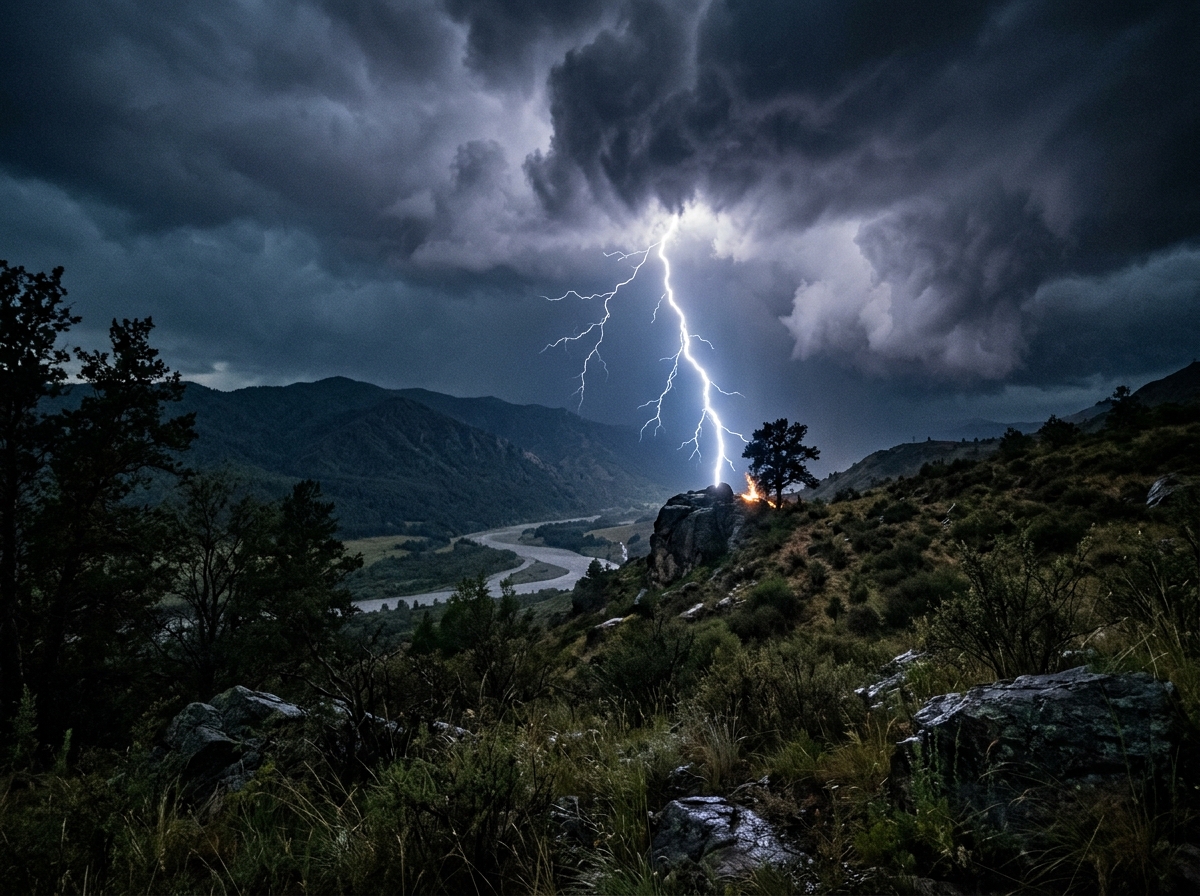
Few natural events are as immediate, violent and unforgettable as lightning.
A flash can illuminate an entire landscape in an instant. A fraction of a second later — or several seconds later, depending on distance — the atmosphere answers with thunder.
Lightning is beautiful from a safe distance. It is also one of nature's most powerful electrical events.
A single strike can kill a person, split a tree, ignite a forest fire, damage electrical equipment, interrupt power systems, destroy electronics, injure livestock, start structural fires and travel through wiring or plumbing inside buildings.
Unlike hurricanes or tornadoes, lightning does not require a huge storm system to become dangerous. One thunderstorm cell may produce dozens, hundreds or even thousands of electrical discharges. And because lightning can strike well away from the heaviest rain, people often underestimate how exposed they really are.
For NaturePulse, lightning and thunder are especially valuable to document because they connect weather · fire · trees · power infrastructure · human safety · agriculture · wildlife · climate · local geography.
What Is Lightning?
Lightning is a massive electrical discharge in the atmosphere. During a thunderstorm, collisions among ice crystals · graupel · supercooled water droplets help separate electrical charge inside the cloud. Different regions of the cloud become electrically charged.
Eventually the difference in electrical potential becomes so large that the insulating ability of the air breaks down. An electrical discharge occurs. That discharge is lightning.
Lightning Can Occur in Several Forms
Not all lightning travels from cloud to ground. Common types include:
- Intra-cloud lightning — occurs within the same cloud. This is the most common type.
- Cloud-to-cloud lightning — travels between separate clouds.
- Cloud-to-ground lightning — connects a cloud with Earth's surface. This is the type people most often associate with danger to people, trees and structures.
- Ground-to-cloud lightning — can originate from tall structures, towers or terrain and propagate upward.
- Cloud-to-air lightning — discharges from cloud into surrounding air.
There are also rare upper-atmospheric electrical phenomena such as sprites, blue jets and elves which occur high above thunderstorms.
How Does a Cloud-to-Ground Strike Form?
The process is extraordinarily fast. A channel of ionized air called a stepped leader moves downward from the cloud in a series of branching steps.
At the same time, upward electrical streamers may rise from trees · buildings · towers · utility poles · the ground.
When the descending and ascending channels connect, a powerful electrical current travels through the channel. This produces the extremely bright flash known as the return stroke. What appears to the human eye as one flash may actually consist of several strokes traveling along the same channel.
How Hot Is Lightning?
Lightning heats the surrounding air to an extraordinary temperature. NOAA educational materials commonly describe the air in a lightning channel as reaching roughly 50,000°F — about 27,000°C — for a brief instant.
That is several times hotter than the surface of the Sun.
The air heats so quickly that it expands explosively. That rapid expansion generates the sound wave we call thunder.
Thunder Is the Sound of Lightning
Thunder is not a separate weather phenomenon. Thunder is *created* by lightning.
*Lightning heats the air almost instantly → air expands violently → a pressure wave forms → thunder.*
Because light travels vastly faster than sound, we see lightning before we hear thunder.
Why Does Thunder Sometimes Crack and Sometimes Rumble?
If lightning occurs close by, thunder may sound like CRACK! or BANG! At greater distances it often becomes a prolonged rumble.
A lightning channel can extend for kilometers. Sound from different parts of that channel reaches your ears at different times. Terrain, clouds and atmospheric conditions can also reflect and distort the sound. This produces the long rolling thunder familiar during summer storms.
How Far Away Is the Lightning?
A rough rule is: count the seconds between flash and thunder, then divide by approximately 5 to estimate the distance in miles.
*Example: 15 seconds ÷ 5 ≈ 3 miles away.*
But this should never be used as a reason to remain outside. If you can hear thunder, lightning is already close enough to be dangerous.
Lightning Can Strike Away From the Rain
One of the most dangerous myths is *"it isn't raining here, so I'm safe."*
Lightning can strike outside the main rainfall area of a thunderstorm. So-called "bolts from the blue" can travel outward from a storm and strike areas under relatively clear skies. A person may therefore be struck before the rain arrives or after it appears to have stopped.
Where Does Lightning Occur Most Often?
Lightning is not evenly distributed around the world. It is especially common in warm, humid regions where strong thunderstorms develop frequently. Tropical regions receive particularly high lightning activity.
Important high-lightning areas occur in Central Africa · South America · Central America · Southeast Asia · parts of South Asia · Southeastern United States · tropical ocean/coastal regions.
The Global Lightning Hotspot: Lake Maracaibo
One of the most famous lightning regions in the world is Lake Maracaibo, Venezuela.
The surrounding geography encourages repeated thunderstorm development. Warm moist air from the lake interacts with mountain circulations, helping produce frequent nighttime thunderstorms.
The phenomenon is often called Catatumbo Lightning. The region can experience extraordinary lightning frequency, making Lake Maracaibo one of the best-known lightning hotspots on Earth.
Central Africa
Parts of Central Africa also experience exceptionally high lightning density. The Congo Basin and surrounding highland regions combine tropical heat · high humidity · strong convection · mountain influences to produce frequent thunderstorms. Some of the world's highest lightning flash densities have been measured in this broad region.
South and Southeast Asia
Thunderstorms are widespread across India, Bangladesh, Sri Lanka, Nepal, Myanmar, Thailand, Indonesia, Malaysia and the Philippines. Seasonal monsoon transitions and pre-monsoon instability can create intense lightning outbreaks.
Lightning in India
India experiences substantial lightning activity, and fatalities remain a major weather-safety concern. Regions particularly prone to severe thunderstorms include parts of Odisha, West Bengal, Bihar, Jharkhand, Uttar Pradesh, Madhya Pradesh, Chhattisgarh, Maharashtra, Andhra Pradesh, Telangana, Assam and Northeast India.
Agricultural workers are especially vulnerable because many strikes occur while people are outdoors in fields · open land · forest edges · roads · water bodies. Pre-monsoon thunderstorms can be especially violent.
Kerala and Lightning
Kerala regularly experiences thunderstorms, particularly during pre-monsoon periods · monsoon transitions · afternoon and evening convective storms. Lightning can affect coconut trees · homes · electrical systems · farm workers · outdoor gatherings.
Tall coconut palms can become prominent strike targets because of their height relative to nearby surroundings.
United States Lightning Risk
Lightning occurs throughout the United States. Florida has long been known for particularly frequent lightning because of its warm climate · abundant moisture · sea-breeze interactions · frequent summer thunderstorms.
Other high-activity areas include portions of the Gulf Coast · Southeast · Great Plains. Mountain areas can also experience dangerous afternoon thunderstorms during summer.
Lightning Over Mountains
Mountainous terrain can encourage thunderstorm development as air is forced upward. This creates major hazards for hikers · climbers · campers · shepherds · outdoor workers. People on exposed ridges are particularly vulnerable. A storm that appears distant can develop or move quickly.
Lightning Fatalities
Lightning kills people every year around the world. The true global total is difficult to determine because reporting is incomplete in many rural and developing regions.
Fatality rates are influenced by more than lightning frequency. They also depend on outdoor occupations · shelter availability · building construction · public awareness · warning systems · access to medical care.
Countries with large agricultural populations may experience substantial casualties because many people work outdoors during thunderstorm seasons.
Who Is Most at Risk?
Higher-risk situations include farmers in open fields · construction workers · fishermen · golfers · hikers · beach visitors · sports participants · people sheltering beneath isolated trees · people on boats · people near water · outdoor festival participants.
Lightning does not require direct contact with the strike point to cause injury.
How Lightning Injures People
Several mechanisms are possible.
- Direct strike — lightning strikes the person directly. Uncommon but extremely dangerous.
- Side flash — lightning strikes a nearby object (often a tree) and part of the current jumps to a person. *This is one reason standing under a tree is dangerous.*
- Ground current — lightning strikes the ground or an object and electrical current spreads through the surface. A person some distance away may be injured by the voltage difference between their feet. Ground current can affect multiple people or animals at once.
- Conduction — lightning travels through electrical wiring · plumbing · metal fencing · other conductive systems and reaches a person indirectly.
- Streamers — electrical channels can rise upward from the ground or objects near a strike. These can also cause injuries.
What Happens to the Human Body?
Lightning injury can affect the heart · brain · nervous system · muscles · hearing · vision · skin. Potential consequences include cardiac arrest · respiratory arrest · burns · neurological injury · hearing damage · memory problems · muscle injury.
A person struck by lightning does not retain an electrical charge and can be touched immediately for rescue. If someone is unresponsive and it is safe to approach, emergency medical assistance and CPR/AED use may be lifesaving.
Lightning and Trees
Trees are among the most visible victims of lightning. A tall tree can provide an attractive pathway for lightning, especially if it stands above its surroundings.
When lightning current travels through a tree, intense heating can vaporize moisture inside the wood. The rapidly expanding steam can split the trunk · blow off bark · shatter branches · cause the tree to explode apart.
Sometimes damage is immediately obvious. Other times a tree survives initially but dies later from internal injury.
Why You Should Never Shelter Under a Tree
A tree may protect you from rain. It does not protect you from lightning. Lightning can strike the tree and then jump to you · travel down the trunk · spread through the ground. An isolated tall tree is especially dangerous.
Lightning Can Start Wildfires
Lightning is an important natural cause of wildfire. A strike can ignite dry grass · trees · dead wood · forest litter.
Some fires ignite immediately. Others smolder unseen inside roots · tree trunks · organic soil and become visible hours or days later. These are sometimes called holdover fires. Remote lightning-caused fires are a major challenge for forest-management agencies.
Dry Lightning
A dangerous situation occurs when thunderstorms produce lightning but little rainfall reaches the ground. This is called dry lightning. It is especially dangerous in drought · dry grasslands · forests · hot windy environments. Multiple lightning strikes can ignite numerous fires over a wide area at the same time.
Lightning and Power Lines
Electrical infrastructure is highly exposed to lightning. A strike can hit transmission lines · distribution lines · utility poles · substations · transformers · communication systems.
Lightning can produce sudden voltage spikes known as surges. These surges can damage equipment even far from the exact strike point.
Transformer Damage
Transformers are designed with protection systems, but severe electrical surges can still cause failure · fire · explosions · local outages. Repair may require replacement equipment.
Power Outages
A lightning strike may cause immediate line faults · protective breaker trips · transformer failures · pole fires · substation damage. Utilities often design their networks to isolate faults rapidly. Some outages therefore last only seconds. Others can persist for hours or days depending on the damage.
Lightning Arresters
Power systems use surge arresters / lightning arresters to help direct dangerous overvoltages safely toward ground. These devices are critical components of modern electrical protection. No protection system can eliminate every lightning-related failure, but proper grounding and surge protection significantly reduce damage.
Lightning and Electronics
Lightning does not have to strike your house directly to damage electronics. A nearby strike can induce electrical surges in power cables · telephone lines · internet connections · antennas.
Devices at risk include computers · TVs · appliances · routers · security systems · smart-home systems · solar equipment.
Whole-house surge protection plus point-of-use surge protection can reduce risk.
Lightning and Solar Panels
Solar installations can also be exposed. Proper systems require grounding · bonding · surge protection · lightning protection where appropriate. Improperly designed systems can suffer damage to inverters · wiring · control electronics.
Lightning and Wind Turbines
Wind turbines are exceptionally tall structures and therefore frequently experience lightning strikes. Modern turbines incorporate protection systems designed to conduct current through blades and towers toward ground. Repeated strikes can still cause expensive blade or electrical damage.
Lightning and Aircraft
Commercial aircraft are struck by lightning periodically. Modern aircraft are designed to conduct electrical current around the exterior and away from critical systems. Passengers may see a flash or hear a sound without the aircraft being seriously damaged. Inspections may nevertheless be required after certain strikes.
Lightning and Boats
Open water is extremely dangerous during thunderstorms. Boaters should return to safe harbor before storms arrive. Lightning can strike masts · antennas · towers · boat structures. Current can travel through onboard electrical systems and water.
Lightning and Livestock
Cattle, horses and other livestock can be particularly vulnerable to ground current. Because animals have relatively large distances between front and rear legs, voltage differences across the ground can cause substantial current to pass through the body.
A single strike may kill several animals standing near one another.
Agricultural Losses
Lightning can damage agriculture through livestock deaths · barn fires · field fires · irrigation-system damage · electrical-system failures · tree damage · greenhouse damage. A lightning strike to an agricultural building may also ignite stored hay or feed.
Lightning Protection for Buildings
Buildings can be protected using a properly engineered Lightning Protection System. A traditional system includes:
- Air terminals (often called lightning rods)
- Conductors — heavy conductive cables provide a path downward
- Grounding system — safely disperses electrical current into the earth
- Bonding — connects conductive building systems to reduce dangerous voltage differences
- Surge protection — protects electrical and electronic systems
The purpose is not necessarily to prevent lightning from striking. The objective is to provide a controlled, low-resistance path for the electrical current.
Benjamin Franklin and the Lightning Rod
Benjamin Franklin's famous experiments helped demonstrate that lightning was electrical. The development of the lightning rod became one of history's most practical applications of scientific discovery. Modern systems are far more engineered than Franklin's original devices, but the central concept remains: give lightning a safer path to ground.
Tall Buildings
Skyscrapers are struck by lightning more frequently because of their height. Modern high-rise buildings incorporate lightning protection · grounding · bonding · surge systems. A strike to a skyscraper may look spectacular without causing serious structural damage when the protection system works properly.
Towers and Communications Infrastructure
Radio towers, television towers and telecommunications masts are also frequent strike targets. They require sophisticated grounding and surge-protection systems to protect antennas · transmitters · receivers · backup power · network equipment.
Churches, Temples and Other Tall Structures
Historically, tall religious buildings were frequently damaged because steeples · towers · domes rose above surrounding buildings. Lightning protection systems became particularly important for these structures.
Lightning Myths
Can Lightning Strike the Same Place Twice?
Yes. The saying *"lightning never strikes the same place twice"* is completely false. Tall structures may be struck many times every year. Lightning responds to electrical conditions and geometry, not superstition.
Does Metal Attract Lightning?
Metal does not "attract" lightning from huge distances in the simplistic sense often imagined. But metal is an excellent conductor. The dangerous issue is that once electrical current reaches metal, it can travel efficiently through it.
During a storm, avoid metal fencing · outdoor plumbing · wired electrical equipment · exposed conductive structures where lightning risk exists.
Does Rubber Protect You?
Rubber-soled shoes do not provide meaningful protection from a direct lightning strike. Similarly, a car is not safe because its tires are made of rubber. A closed metal vehicle protects occupants mainly because the metal body can conduct current around the passenger compartment — a principle related to a Faraday cage.
Safe Places During Lightning
The safest ordinary options are a substantial enclosed building or a fully enclosed hard-topped vehicle.
Avoid open shelters · gazebos · picnic structures · trees · tents · beaches · open fields.
Indoor Lightning Safety
Being indoors substantially reduces risk, but lightning can enter buildings through conductive pathways. During a severe thunderstorm, avoid unnecessary contact with corded electrical equipment · plumbing · showers · sinks · windows · concrete surfaces containing metal reinforcement.
Wireless devices operating on battery power are generally much safer than equipment connected directly to wiring.
The 30-Minute Safety Principle
Do not rush outside immediately after the last nearby thunder. A storm may still be producing lightning. A commonly used safety principle is to wait approximately 30 minutes after the last thunder before resuming exposed outdoor activities.
Thunderstorm Safety for Sports
Outdoor sporting events should have a written lightning plan. This includes who monitors weather · who orders evacuation · where participants go · how long evacuation takes · when activity can resume. Waiting until lightning is directly overhead is too late.
Beaches and Swimming Pools
Water does not "attract" lightning in the simplistic sense, but open water offers no meaningful shelter. Swimmers should leave pools · lakes · rivers · ocean water when thunderstorms threaten. Beachgoers should move to substantial buildings or enclosed vehicles.
Golf Courses
Golfers face multiple hazards: open terrain · isolated trees · metal clubs · distance from shelter. If thunderstorms threaten, leave the course early. A golf cart that is open on the sides does not provide the same protection as a fully enclosed hard-topped vehicle.
Camping
A tent offers almost no lightning protection. Campers should understand the local thunderstorm pattern before setting up camp. Avoid campsites on exposed ridges · beside isolated tall trees · in open fields. During storms, seek a substantial shelter or appropriate enclosed vehicle whenever possible.
Lightning and Climate
Lightning frequency is influenced by temperature · moisture · atmospheric instability · storm dynamics · geography. Scientists continue studying how lightning activity may change as Earth's climate warms. A warmer atmosphere can alter the environments in which strong convection develops, but changes are not expected to be uniform everywhere.
Long-term lightning observations are therefore particularly useful.
Satellite Lightning Monitoring
Modern satellites can observe lightning over enormous areas. These systems help meteorologists monitor thunderstorm development · intensification · severe weather · remote storms. Lightning activity can sometimes increase rapidly as a storm strengthens. This provides another valuable piece of information alongside radar and conventional weather observations.
Ground-Based Lightning Networks
Ground detection networks use sensors to estimate strike location · time · polarity · intensity. These networks can map enormous numbers of lightning events. Combining satellite and ground networks provides scientists with an increasingly detailed view of Earth's electrical storms.
The Brutal Energy of Lightning
Lightning is extraordinary because an enormous amount of electrical power is concentrated into a very brief event.
A typical lightning discharge can involve tens of thousands of amperes of current · extremely high voltage · temperatures around 27,000°C in the channel. Some strikes are substantially stronger than average.
The total usable energy in a lightning flash is not as simple as multiplying headline voltage and current values because lightning consists of extremely short and complex pulses. Nevertheless, the instantaneous power can be enormous.
That is why a lightning strike lasting only milliseconds can vaporize moisture · melt metal · ignite wood · explode bark from a tree · damage electronics · stop a human heart.
The violence is created not by long duration, but by an immense release of electrical energy in an extraordinarily short period.
Why Can't We Capture Lightning to Power Cities?
People often ask: *could we capture lightning and use it as electricity?*
The idea is attractive but technically difficult. Lightning is extremely brief · unpredictable in location · extremely high power · difficult to store efficiently · expensive to capture safely.
Modern energy systems work better with predictable energy sources that can be generated and controlled continuously. The spectacular power of lightning does not automatically make it a practical energy source.
Lightning Can Melt Sand
When lightning travels through sandy soil, its heat can fuse silica into glass-like structures known as fulgurites. These branching formations preserve the path of electrical current through the ground. They are literal geological records of lightning.
Lightning Can Alter Rocks
Powerful strikes can also produce fractures · magnetic changes · melted surfaces in exposed rocks. Lightning therefore leaves traces not only in trees and buildings but sometimes in geology itself.
NaturePulse and Lightning
NaturePulse could create a valuable Global Lightning Observation Archive.
Users could document lightning · thunderstorms · tree strikes · power outages · fires · hail · heavy rain · damage — and connect those observations to GPS · weather data · satellite lightning detections · official strike networks · fire reports.
NaturePulse Lightning Observation Form
Location — GPS · country · state/province · district/county · city/village.
Date and time — automatically captured when possible.
Observation:
- Lightning visible
- Thunder heard
- Direct strike observed
- Tree struck
- Building struck
- Power line struck
- Transformer affected
- Fire started
- Power outage
- Other
Estimate Storm Distance
If the observer recorded lightning time and thunder time, NaturePulse could calculate the approximate distance.
*Example: Flash 5:42:10 PM · Thunder 5:42:25 PM · difference 15 seconds → approximately 3 miles / 5 kilometers.*
Clearly identify this as an approximation.
Document Tree Strikes
Tree observation fields could include tree species · approximate height · bark damage · split trunk · fire · branch damage · alive/dead · follow-up condition.
Then users could return 1 month later · 1 year later · 5 years later to document whether the tree survived.
Document Power Infrastructure Damage
Useful categories: utility pole · transformer · power line · substation · streetlight · communication tower.
Record time · GPS · visible damage · power outage Y/N · restoration time if known.
Do not encourage people to approach electrical equipment.
NaturePulse Safety Warning
Place this prominently:
> ⚠️ Never approach a lightning-struck power line, pole, transformer, tree or damaged structure to obtain a photograph. Stay well away from downed electrical lines and follow utility and emergency instructions. Safety comes before documentation.
Lightning and Wildfire Observations
If lightning starts a wildfire, link:
Lightning event → fire event → forest / grassland → weather → damage → recovery.
This creates a powerful environmental timeline.
Lightning Hotspot Maps
NaturePulse could eventually show 🌩 Lightning observations this week. Users could zoom world → country → state → city and explore citizen reports. When official lightning-network data can legally be integrated, display that separately from citizen observations.
Thunder as an Audio Observation
NaturePulse should not depend only on photographs. Users could upload short recordings of thunder · rain · hail · wind.
A thunder recording could be tagged with GPS · date · time · storm · approximate distance. This creates another dimension of environmental documentation.
Lightning Is Both Creative and Destructive
Lightning has existed long before humans. It plays a role in wildfire ecology · atmospheric chemistry · nitrogen processes · natural ecosystem disturbance. Some ecosystems have evolved alongside lightning-caused fires.
Yet when lightning intersects with people · buildings · power grids · farms · fuel-dry forests, the consequences can be severe.
One Flash Can Change Everything
A lightning strike may last only a fraction of a second. But in that instant it can:
- Kill a person.
- Split a 100-year-old tree.
- Start a forest fire.
- Destroy a transformer.
- Knock out electricity to thousands of homes.
- Damage a computer network.
- Burn a building.
- Kill livestock.
- Create glass in the ground.
That is the brutal nature of lightning: extraordinary energy concentrated into an instant.
Respect Thunder
Thunder provides one of nature's simplest warning systems. You do not need radar · satellite imagery · a weather app · a meteorology degree to understand its message.
If you hear thunder, lightning is close enough to threaten you.
- Seek shelter.
- Do not wait for rain.
- Do not stand under a tree.
- Do not continue swimming.
- Do not remain on an exposed ridge.
- Do not risk your life for a photograph.
NaturePulse.net — Observe · Record · Understand · Respect
Lightning is one of the fastest events NaturePulse can document. A flash may exist for milliseconds. Thunder may disappear within seconds.
But the evidence may remain: a scarred tree · a burned field · a damaged transformer · a wildfire · a personal story.
By combining these observations with time, GPS, photographs, audio and authoritative weather data, NaturePulse can help preserve a global record of Earth's extraordinary electrical storms.
The flash disappears instantly. The story it leaves behind can last for generations.