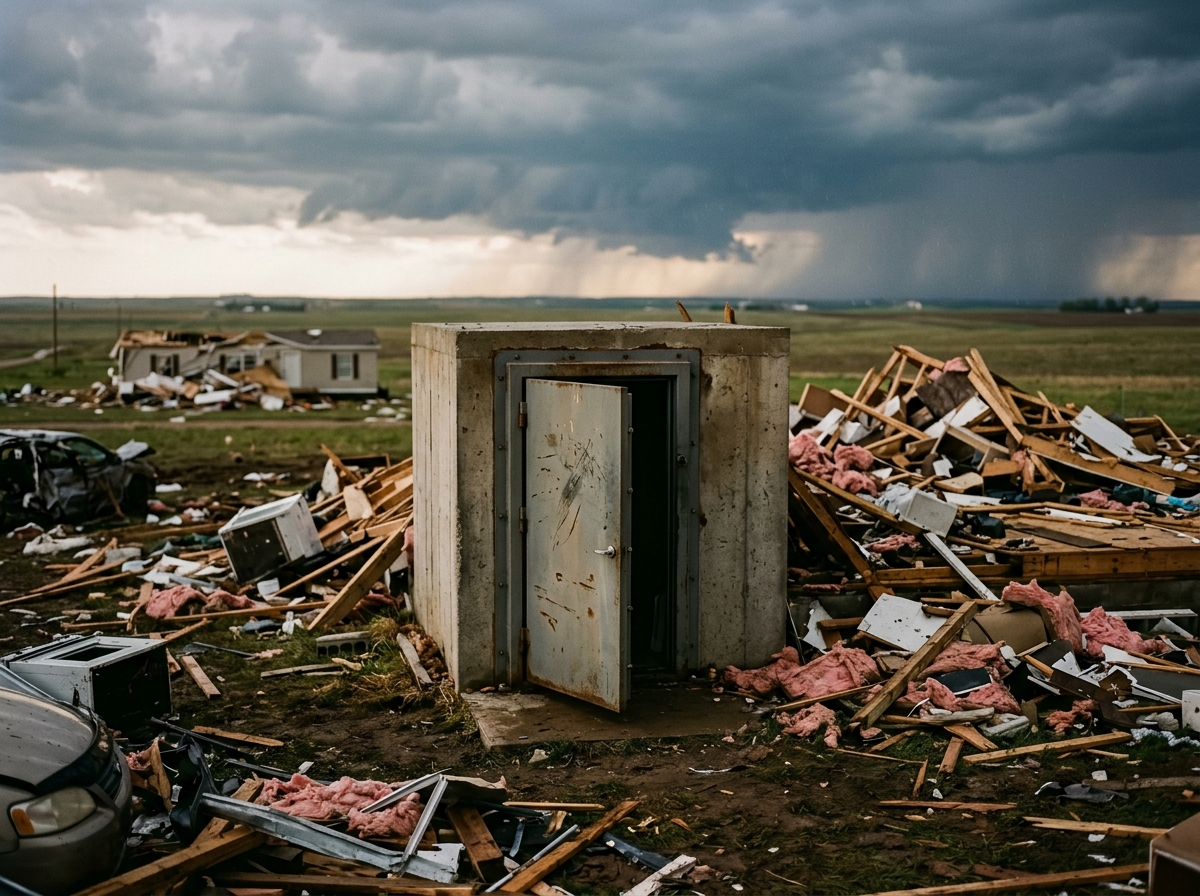
Few natural phenomena combine such extraordinary power with such a small physical footprint as a tornado.
A tornado can descend from a thunderstorm, cross a neighborhood in minutes, destroy one building while leaving another nearby relatively intact, throw vehicles through the air, strip roofs from houses, drive debris through walls and then disappear almost as quickly as it formed.
Unlike hurricanes, which can often be tracked for days, tornadoes can develop rapidly and change direction or intensity over short periods. Modern radar, satellites, weather models, storm spotters and warning systems have dramatically improved our ability to recognize dangerous conditions, but scientists still cannot predict the exact street a tornado will follow hours in advance.
That combination of enormous force + small scale + rapid development + uncertain path is what makes tornadoes so dangerous.
For NaturePulse, tornadoes are also an important environmental phenomenon to document. A tornado affects much more than buildings. It can alter forests, farmland, wildlife habitat, waterways and entire landscapes within minutes.
What Is a Tornado?
A tornado is a violently rotating column of air extending from a thunderstorm to the ground.
The visible funnel that people associate with tornadoes is formed when moisture condenses within the rotating air. But the circulation itself can extend beyond the visible condensation funnel. A tornado may therefore already be causing damage even when the visible funnel does not appear to reach the ground.
Dust, soil, vegetation and debris swirling beneath the funnel can sometimes provide the first obvious indication that tornadic circulation has reached the surface.
Tornadoes Begin Inside Thunderstorms
Most strong tornadoes develop from powerful thunderstorms known as supercells. A supercell contains a persistent rotating updraft called a mesocyclone. But not every supercell produces a tornado.
The atmosphere must contain a particular combination of ingredients:
- Warm, moist air near the surface — provides energy and moisture for thunderstorms.
- Cooler, drier air above — the temperature contrast helps create atmospheric instability.
- Atmospheric instability — warm air wants to rise through cooler air above it.
- Wind shear — wind changes speed and/or direction with height. Strong wind shear can create horizontal rotation in the atmosphere.
- Powerful thunderstorm updrafts — the rising air within the storm can tilt this horizontal rotation into the vertical.
Under favorable conditions, rotation becomes increasingly concentrated and a tornado may develop.
NOAA's National Severe Storms Laboratory emphasizes that tornado formation remains an active scientific research area and that not every rotating supercell ultimately produces a tornado.
A Simplified Tornado Formation Sequence
*Warm moist air + atmospheric instability + strong wind shear → powerful thunderstorm → rotating updraft → mesocyclone → rotation tightens near the ground → tornado.*
The actual physics are considerably more complicated, which is one reason tornado forecasting remains challenging.
How Powerful Can a Tornado Become?
Tornadoes produce some of the strongest winds observed near Earth's surface. Because it is extremely difficult and dangerous to place instruments directly inside the strongest part of a tornado, wind speeds are often estimated from damage.
In the United States, tornado damage is rated using the Enhanced Fujita Scale — EF Scale.
The National Weather Service introduced the Enhanced Fujita Scale in 2007. It uses observed damage to structures and vegetation to estimate likely wind-speed ranges. NOAA notes that the system examines multiple damage indicators and degrees of damage rather than simply assigning intensity from a single destroyed object.
Enhanced Fujita Scale
| Rating | Estimated Wind Speed | Typical Potential Damage |
|---|---|---|
| EF0 | 65–85 mph | Light damage |
| EF1 | 86–110 mph | Moderate damage |
| EF2 | 111–135 mph | Considerable damage |
| EF3 | 136–165 mph | Severe damage |
| EF4 | 166–200 mph | Devastating damage |
| EF5 | Over 200 mph | Incredible destruction |
These wind speeds are estimates inferred from damage, not necessarily direct measurements of the tornado's highest instantaneous wind.
What Can Each Category Do?
- EF0 — even the weakest tornado can break tree limbs · damage roofs · remove shingles · damage signs · move unsecured outdoor objects · damage lightweight structures. Flying debris can injure people.
- EF1 — remove substantial roof covering · damage mobile homes · break windows · overturn vehicles · uproot trees · damage garages and outbuildings.
- EF2 — damage can become severe. Tear roofs from well-built houses · shift homes from foundations · destroy mobile homes · snap or uproot large trees · lift vehicles.
- EF3 — destroy entire upper floors · collapse poorly built structures · throw heavy vehicles · damage large commercial buildings · uproot forests. Survival without adequate shelter becomes increasingly difficult.
- EF4 — devastate communities. Well-built homes can be destroyed. Vehicles can become airborne. Large debris becomes extraordinarily dangerous.
- EF5 — the most extreme damage category. Estimated winds exceed 200 mph. Well-constructed homes may be swept from foundations. Trees can be stripped of bark and branches. Fortunately, tornadoes of this intensity are rare.
NIST reports that the overwhelming majority of U.S. tornadoes are EF0–EF2; its analysis underlying new building provisions found that these lower intensities account for roughly 95–97% of tornado occurrence depending on the dataset.
The Hidden Killer: Flying Debris
Extreme wind is dangerous. But much tornado injury and destruction is caused by flying debris.
A piece of lumber, roofing material, glass, metal or other debris moving at tremendous speed becomes a projectile. This is why simply making walls stronger is not enough. Doors, windows, garage doors and roof connections can all become critical vulnerabilities.
Once the building envelope is breached, pressure and wind can contribute to progressive structural failure.
Tornadoes Can Throw Vehicles
Cars, pickup trucks, trailers and even large vehicles can be moved or overturned by intense tornado winds. A vehicle is therefore not a safe tornado shelter.
People should not intentionally drive toward or underneath a tornado in an attempt to photograph or observe it. Professional storm researchers operate with specialized training, instruments and risk-management procedures.
Tornadoes Are Remarkably Unpredictable
Weather forecasters have become increasingly skilled at predicting when atmospheric conditions favor severe thunderstorms and tornadoes. But there are several levels of prediction.
Meteorologists can often forecast *a region where tornadoes may be possible tomorrow.* As storms develop, radar may identify rotating thunderstorms. A warning may then identify a much smaller area where a tornado is occurring or imminent.
What meteorologists generally cannot provide far in advance is *"a tornado will cross this exact house at 4:17 PM."*
Tornadoes can form rapidly · strengthen rapidly · weaken rapidly · change direction · cycle through multiple tornadoes · become obscured by rain · occur at night · form with limited visual warning. That is why warnings must be taken seriously.
Tornado Watch vs. Tornado Warning
These terms should never be confused.
- Tornado Watch — conditions are favorable for tornado development. *Be prepared.* Monitor weather information. Know where your shelter is. Keep phones charged. Bring children and pets close.
- Tornado Warning — a tornado has been indicated by radar or reported by spotters and presents a serious threat. *Take shelter immediately.*
NOAA explicitly advises people in a tornado warning to act immediately and find safe shelter. Do not wait until you see the tornado.
You May Never See the Tornado Coming
Some tornadoes are hidden by heavy rain · darkness · buildings · trees · hills · low clouds. Rain-wrapped tornadoes can be especially dangerous. At night, visual confirmation may be virtually impossible.
Your first warning may be a phone alert · weather radio · siren · television · radar — rather than seeing a funnel.
Tornado Sirens Are Not Designed to Wake Everyone Indoors
Outdoor warning sirens are primarily designed to alert people who are outside. Do not depend on a siren as your only warning method. Use multiple systems: wireless emergency alerts · weather apps · NOAA Weather Radio where available · local emergency alerts · television/radio · community notification systems.
Redundancy saves lives.
Where Do Tornadoes Occur?
Tornadoes can occur in many countries. They have been documented on every continent except Antarctica. But they are particularly common in certain atmospheric environments.
The United States experiences more reported tornadoes than any other country, largely because its geography frequently allows warm moist Gulf air to interact with cold dry northern air and dry air from the western United States and Mexico while powerful upper-level winds create substantial wind shear.
Tornado Alley
Historically, the term Tornado Alley referred primarily to areas of the central Great Plains, including portions of Texas, Oklahoma, Kansas, Nebraska, South Dakota. But tornado risk extends far beyond this traditional corridor.
The Southeast United States
States across the Southeast also experience substantial tornado activity: parts of Mississippi, Alabama, Arkansas, Tennessee, Louisiana, Georgia.
This region presents several additional hazards. Tornadoes may occur at night · during cooler parts of the year · in densely wooded terrain · in areas containing many manufactured homes.
Tornadoes can be harder to see, and vulnerable housing can increase casualties.
Tornado Risk Extends Across Much of the United States
Tornadoes occur in states far outside traditional Tornado Alley. They can affect Florida · the Carolinas · Midwest · Ohio Valley · Northeast · Mountain West · Pacific Northwest. The frequency and intensity vary greatly, but almost no region should assume tornadoes are impossible.
NIST's residential tornado-resilience guidance describes the tornado-prone portion of the continental United States broadly as the area east of the Continental Divide.
Tornadoes in Canada
Canada experiences significant tornado activity, particularly across parts of Alberta · Saskatchewan · Manitoba · Ontario · Quebec. Southern Canada shares some of the same atmospheric ingredients responsible for severe weather across the United States.
Tornadoes in Europe
European tornadoes receive less international attention but occur regularly. Countries reporting tornadoes include the United Kingdom · Germany · France · Italy · Spain · Netherlands · Belgium · Poland · Czech Republic · Romania. Some Mediterranean tornadoes and waterspouts can also be significant.
Tornadoes in India
India experiences tornadoes less frequently than the United States, but destructive events do occur. Eastern and northeastern regions can be particularly vulnerable to violent thunderstorms.
Areas historically affected include portions of West Bengal, Odisha, Assam, Bihar, Northeast India. Severe pre-monsoon thunderstorms locally known in parts of eastern India as Kalbaisakhi or Nor'westers can produce damaging winds, hail and occasionally tornadoes.
Because detailed tornado records are less comprehensive in many countries, historical comparisons must be made carefully.
Bangladesh
Bangladesh has experienced some exceptionally deadly tornadoes. Several factors contribute to vulnerability: high population density · vulnerable housing · severe thunderstorms · limited shelter access in some communities.
A tornado does not have to reach the extreme width or duration of a major U.S. tornado to cause catastrophic casualties when it passes through densely populated settlements.
South America, Australia, Africa
Strong tornadoes occur in parts of Argentina, Uruguay, southern Brazil, Paraguay. The plains of central South America can produce atmospheric conditions similar in some respects to severe-weather environments in North America.
Australia also experiences tornadoes. Many are relatively weak, but damaging tornadoes have occurred. Severe thunderstorms in Australia can produce tornadoes · giant hail · destructive straight-line winds · flash flooding.
Tornadoes and tornado-like severe storms occur in parts of Africa, especially southern Africa. Reporting networks vary, so global tornado frequency maps partly reflect where observations and verification systems are strongest, not simply where atmospheric vortices occur. This is an important distinction for NaturePulse.
Waterspouts
A waterspout is a rotating column of air over water. There are two broad types:
- Tornadic waterspout — essentially a tornado associated with a severe thunderstorm that occurs over water.
- Fair-weather waterspout — often develops under less severe conditions and has a different formation process.
Waterspouts can move ashore and become dangerous to coastal communities.
Tornado Width and Path Length
Tornado size varies enormously. Some tornadoes may only be tens of meters wide. Others can exceed a kilometer. Exceptionally large tornado circulations can be several kilometers across.
But width alone does not determine intensity. A relatively narrow tornado can be extremely violent. A very wide tornado may contain areas of substantially different wind intensity.
Some tornadoes touch down briefly and travel only a short distance. Others remain on the ground for tens of kilometers. Long-track tornadoes can affect multiple towns and counties. The damage path is often irregular because tornado intensity can fluctuate dramatically during its lifetime.
Multiple-Vortex Tornadoes
Some powerful tornadoes contain smaller rotating vortices moving around the larger circulation. These are called suction vortices or sub-vortices.
They can help explain why one house experiences extraordinary destruction while a nearby structure suffers substantially less damage. Tornado damage can therefore look strangely selective.
Why One House Survives and the Neighbor's Does Not
People sometimes interpret irregular tornado destruction as mysterious. But small differences can matter greatly: exact wind exposure · debris impacts · building orientation · roof connections · garage-door failure · construction quality · internal pressure · sub-vortex location · terrain · distance from tornado core.
A tornado's wind field is not uniform.
How to Survive a Tornado
The most important objective is: put as many strong barriers as possible between you and the tornado.
The best available location depends on the building.
Best Option: Tornado Safe Room or Storm Shelter
A properly designed tornado safe room provides the highest level of protection. FEMA's safe-room guidance is designed to provide near-absolute protection when appropriate criteria are followed, including the ICC 500 storm shelter standard.
Safe rooms may be inside a house · attached to a house · inside a garage · in a basement · underground · above ground · stand-alone · community shelters.
Proper engineering matters enormously. A small closet with reinforced-looking walls is not automatically a certified safe room.
If You Have a Basement
Move to the basement. Choose an area away from windows · away from heavy objects above · under sturdy structural protection when possible.
Use helmets · mattresses · blankets · pillows to help protect against debris. A FEMA/ICC-compliant safe room is still preferable when available.
If You Don't Have a Basement
Go to a small interior room on the lowest floor. Examples: interior bathroom · closet · hallway · interior storage room. Stay away from windows and place as many walls as possible between yourself and outside.
Protect Your Head and Neck
Head trauma is a major danger. Use a bicycle helmet · sports helmet · mattress · heavy blanket · pillow · sturdy furniture where appropriate.
Children should also have head protection available in designated shelter locations. A useful household tornado kit can include helmets for every family member.
Wear Shoes
Tornado debris frequently includes broken glass · nails · wood · metal. Keep sturdy shoes in or near your tornado shelter. After the storm, walking barefoot can result in serious injury.
Keep Important Items in the Shelter Area
Consider keeping flashlight · battery power bank · weather radio · water · first-aid kit · whistle · shoes · helmets · essential medications · identification · pet leash/carrier. Do not waste warning time collecting everything around the house.
What If You Live in a Mobile or Manufactured Home?
Manufactured homes can be extremely vulnerable to tornado winds. Do not remain in one during a tornado if a safer shelter is accessible.
Plan before severe weather begins to reach a community storm shelter · properly constructed safe room · substantial nearby building. Do not wait until the tornado is visible before leaving.
What If You Are in a High-Rise?
Move toward lower floors if there is adequate time · interior stairwells · windowless interior rooms · structurally protected areas designated by building management. Stay away from large glass windows. High-rise buildings can experience significant flying glass and facade damage even when the entire structure remains standing.
What If You Are in a School?
Follow the school's tornado plan. Students should generally be moved away from windows · large-span gymnasiums · auditoriums · cafeterias unless those spaces contain properly engineered storm shelters.
Modern building codes increasingly require storm shelters for certain schools in highly tornado-prone U.S. regions. NIST notes that tornado shelter requirements now apply to new school and emergency-response facilities in parts of numerous tornado-prone states.
What If You Are in a Store or Shopping Center?
Large open-span buildings can be vulnerable because roof systems may cover enormous areas with limited interior support. Move toward designated storm shelter · interior reinforced rooms · smaller enclosed areas. Avoid glass storefronts · atriums · large open sales floors · skylights. Follow staff emergency instructions.
What If You Are Driving?
Vehicles are poor tornado shelters. If there is sufficient time and a clearly safer substantial building is nearby, reach it. But do not attempt to outrun a tornado through congested roads or uncertain terrain.
Never shelter under a highway overpass. Overpasses can expose people to intense winds and flying debris, and stopping underneath them can block roads needed by others.
If no substantial shelter is available, follow current local emergency guidance for the specific circumstances rather than relying on one universal roadside rule.
Do Not Open Windows
One of the oldest tornado myths advised people to open windows to *"equalize pressure."* Do not waste precious sheltering time doing this. Your priority is shelter immediately. Broken windows also increase exposure to wind and flying debris.
Do Not Stand at the Window Watching
A tornado can move faster than expected. Windows may shatter. Debris can arrive before the visible funnel. Take shelter.
NaturePulse users should be explicitly instructed: never risk your safety to obtain a photograph or video.
After the Tornado
Danger does not end when the wind stops. Potential hazards include downed electrical lines · gas leaks · fires · broken glass · unstable buildings · damaged trees · floodwater · hazardous chemicals · exposed nails · additional thunderstorms.
Remain alert for additional warnings. A thunderstorm may produce more than one tornado.
Can We Build a Tornado-Proof House?
For ordinary residential construction, the phrase *"tornado-proof house"* should be used carefully. Designing an entire conventional home to remain completely undamaged during a direct strike from the most violent EF5 tornado would be extraordinarily difficult and expensive.
But homes can absolutely be built more tornado-resistant. And safe rooms can be engineered to provide extremely high levels of life-safety protection.
These are different objectives.
Building Objective #1: Keep the House Together
A building behaves as a system. The desired structural pathway is:
*Roof → walls → floor → foundation.*
This is called a continuous load path. Every major part should be securely connected to the next.
NIST recommends strengthening this load path as one of the primary ways to improve tornado resistance in one- and two-family homes.
Strong Roof-to-Wall Connections
Roofs can experience enormous uplift forces. Improved connections can include appropriately engineered hurricane clips · metal straps · structural anchors. The roof should not simply rest on the walls. It should be mechanically connected into the building's structural system.
Wall-to-Foundation Connections
The walls must also remain securely attached to the foundation. Properly engineered anchors and connections help create a continuous structural pathway from roof to foundation.
Strengthen the Roof
Roof failure frequently initiates substantial building damage. Tornado-resistant strategies can include improved roof sheathing attachment · stronger fastener patterns · enhanced roof-to-wall connections · wind-resistant roofing systems · properly designed roof geometry. These should follow local building codes and professional engineering recommendations.
Protect Windows and Openings
If windborne debris breaks a large opening, internal pressure and wind intrusion can increase structural loads. Impact-resistant glazing or shutters may help in certain applications. NIST specifically identifies stronger building-envelope components and opening protection as part of improving residential tornado resistance.
Garage Doors Are a Major Vulnerability
Garage doors can present one of the largest openings in a house. Failure can allow powerful winds into the building. A tornado- and wind-resilient home should use appropriately rated garage-door systems and connections.
Exterior Doors
Doors should have strong frames · appropriate anchoring · durable hinges · secure locking/latching systems. The entire opening is only as strong as its weakest component.
Stronger Walls
Depending on design, tornado-resistant construction may use reinforced concrete · insulated concrete forms · reinforced masonry · properly engineered wood framing · structural sheathing systems · steel structural systems. But material alone does not guarantee safety. A poorly connected concrete or steel building can still fail.
The Most Important Room: The Safe Room
Rather than trying to make every room survive the most extreme tornado, one highly effective strategy is to create a small hardened space designed specifically for life safety.
A safe room must resist extreme wind pressure and high-speed debris impact. FEMA's current P-361 guidance references the 2023 ICC 500 Standard for the Design and Construction of Storm Shelters.
Safe-Room Construction
Depending on the engineered design, safe rooms may use reinforced concrete · reinforced concrete masonry · steel · engineered wood assemblies.
But the entire system matters. That includes walls · ceiling · floor/foundation · door · hinges · latches · ventilation openings · anchoring. A tornado-rated door is especially important. Ordinary residential doors cannot be assumed to withstand tornado debris impacts.
Above-Ground Safe Rooms Can Work
A common misconception is: *"Only an underground shelter can protect you from a violent tornado."*
Properly engineered above-ground safe rooms can provide extremely high levels of protection. NIST notes that advances in tornado engineering have demonstrated that life-safety protection does not have to depend exclusively on underground sheltering.
This is important in locations where groundwater is high · flooding is a concern · soil conditions complicate excavation · accessibility makes underground shelters difficult.
Underground Shelters
Underground tornado shelters remain excellent options when properly designed and installed. But they require consideration of flooding · drainage · entrances · emergency exits · ventilation · accessibility · debris blocking the exit. People with limited mobility may find above-ground safe rooms more practical.
Community Storm Shelters
Schools, apartment complexes, workplaces, manufactured-home parks and neighborhoods can provide shared shelters. Important considerations include capacity · distance · accessibility · opening procedures · warning time · lighting · ventilation · emergency communication.
A shelter that takes 15 minutes to reach may not help if a tornado warning provides only a few minutes of actionable time.
Building Codes Are Changing
For much of modern building-code history, ordinary buildings were designed for severe straight-line winds but not specifically for tornado wind loads. That has begun to change.
NIST research led to the first tornado-load requirements in ASCE 7-22 and subsequently into the 2024 International Building Code for certain high-occupancy and critical facilities. These provisions are especially relevant to buildings such as hospitals · fire stations · police stations · schools · emergency facilities · high-occupancy structures.
This represents a major evolution in tornado resilience.
Why Buildings Don't Have to Survive EF5 Winds Everywhere to Save Lives
Designing every building in tornado country for a direct EF5 impact would be extremely expensive. Fortunately, the strongest tornado wind speeds occupy a relatively small portion of most tornado damage paths.
NIST's analysis of the 2011 Joplin tornado found that even though it reached EF5 intensity, roughly 70% of its affected area experienced EF2-or-lower damage intensity.
This leads to an important resilience principle: strengthening ordinary buildings against more common EF0–EF2 conditions can substantially reduce overall damage even when an exceptionally violent tornado occurs. Then use hardened safe rooms for life safety during the most extreme portion of the storm.
Tornado-Resilient Neighborhoods
Protection should not stop with individual houses. Communities can improve resilience by enforcing modern building codes · installing community shelters · strengthening schools · protecting hospitals · hardening emergency facilities · burying vulnerable utilities where practical · improving warning systems · maintaining emergency communications · planning debris removal · mapping vulnerable populations.
Resilience is both an engineering problem and a community-planning problem.
Tornadoes and Climate Change
The relationship between tornadoes and climate change is more complicated than simply asking *"will global warming produce more tornadoes?"*
Tornadoes are extremely small-scale phenomena compared with the resolution of many climate models. The atmospheric ingredients associated with severe thunderstorms can change in different and sometimes competing ways.
Researchers examine variables such as atmospheric instability · moisture · wind shear · seasonal timing · geographic distribution.
Scientists have reported changes in where and when severe tornado environments and tornado activity occur, but attributing individual tornadoes or simple global tornado counts directly to climate change requires caution.
NaturePulse should therefore avoid simplistic statements such as *"climate change caused this tornado."* Long-term geographic and seasonal observations, however, can contribute to understanding changing patterns.
Tornado Season Is Not One Fixed Period
In the United States, tornado activity tends to migrate geographically through the year. Broadly: greater risk can occur in parts of the Southeast in late winter/early spring · activity becomes prominent in the Southern and Central Plains in spring · risk often shifts farther north into the Central and Northern Plains in late spring/early summer.
But tornadoes can occur in any month when atmospheric conditions are favorable.
Tornadoes at Night
Nighttime tornadoes are particularly dangerous. People may be sleeping · unable to see the storm · less aware of warnings · farther from shelters.
Every household in tornado-prone areas should have at least one warning method capable of waking sleeping occupants.
The Psychological Impact of Tornadoes
Tornado damage can be intensely personal. Within seconds a family may lose home · photographs · vehicles · pets · neighborhood · workplace. Children and adults can experience long-lasting stress after a disaster.
Community recovery therefore includes more than rebuilding structures. It includes restoring social networks, schools, businesses, healthcare and a sense of security.
Tornadoes Transform Nature Too
Tornadoes are usually described through human damage. But they can cause major ecological changes. A strong tornado can flatten forests · uproot mature trees · strip vegetation · damage crops · kill wildlife · destroy nests · change stream channels · scatter invasive plant material · create large quantities of woody debris · alter sunlight reaching forest floors.
These changes can persist for decades.
Tornado Damage to Forests
A powerful tornado crossing mature woodland may leave a visible corridor of downed trees. Satellite imagery can sometimes reveal these paths.
Over subsequent years the damaged forest undergoes succession. New vegetation grows. Sun-loving species colonize openings. Dead timber becomes habitat. The ecological consequences can therefore continue long after the tornado itself disappears.
Agriculture
Tornadoes can destroy crops · barns · irrigation systems · livestock facilities · grain storage · farm machinery · orchards · greenhouses. A tornado striking during harvest can create enormous economic losses within minutes.
NaturePulse and Tornado Documentation
NaturePulse.net can play a unique role. It should never replace the National Weather Service · NOAA · emergency managers · official warning systems.
Instead, NaturePulse can become a global tornado observation and historical record. Citizen observations can supplement professional meteorological information.
What NaturePulse Users Could Document
After it is safe, contributors could record tornado sighted · funnel cloud · rotating wall cloud · hail · extreme wind · tree damage · building damage · crop damage · forest damage · power infrastructure damage · road blockage · flooding · wildlife effects · post-tornado landscape.
Important Safety Rule for NaturePulse
Place this prominently on every severe-weather submission page:
> ⚠️ Never put yourself in danger to obtain a NaturePulse observation.
>
> Do not approach a tornado, flooded road, unstable building, fallen power line or damaged forest simply to photograph it. Your safety comes before documentation.
NaturePulse Tornado Observation Form
Event information — date · time · GPS · country · state/province · county/district · city/town.
Observation type — funnel cloud · tornado · possible tornado · wind damage · hail · debris · other.
Personal experience — did you personally see the tornado? Were you indoors? Approximate duration. Direction of movement.
Media — photos · video · description.
Damage observed — trees · crops · house · commercial building · road · vehicles · power lines · other.
Never Let AI Declare a Tornado From One Photograph
NaturePulse AI may say *"possible funnel cloud"* or *"image appears consistent with tornado damage"* but should not automatically label uncertain observations *"confirmed tornado."* Whenever possible, match community observations with authoritative meteorological records.
Connect Citizen Reports to Official Tornado Records
*Example: NaturePulse observation — user reported violent wind and tree damage at 6:42 PM.*
Then automatically search official data. *Possible matching event: confirmed tornado · rating EF2 · official path 17 miles · maximum width 800 yards · official source National Weather Service.*
Now NaturePulse preserves scientific event · human experience · photographs · GPS · damage · recovery.
Before and After Tornado Documentation
This could become one of NaturePulse's strongest features. Suppose NaturePulse already contains photographs of a forest or farm. Then:
*Before tornado — May 2027 → tornado June 2027 → immediately after June 2027 → one year later June 2028 → five years later June 2032.*
Users and researchers could visually study environmental recovery.
Adopt a Tornado-Affected Location
NaturePulse could encourage residents, schools and environmental groups to adopt a location and revisit it periodically.
Document tree recovery · vegetation · wildlife · building reconstruction · agricultural recovery · stream changes · soil erosion. A tornado lasting five minutes could generate a 50-year environmental record.
What Every Household in Tornado Country Should Know
The most important tornado-survival principles can be summarized simply:
Before: Know where you will shelter. Have multiple warning systems. Keep shoes and helmets near your shelter. Plan for children, elderly family members and pets. Know whether your home has an adequate shelter.
During: When warned, go immediately. Choose *safe room → basement → lowest-floor interior room* in that order when available. Stay away from windows. Protect your head and neck. Do not go outside to watch.
After: Watch for power lines · gas leaks · fires · broken glass · unstable structures · additional storms. Help others when it can be done safely. Do not enter severely damaged buildings until authorities determine they are safe.
The Most Important Lesson About Tornadoes
Humanity cannot stop tornadoes. We probably will never control them.
But a tornado does not automatically have to become a mass-casualty disaster.
The difference can be:
- 30 seconds of warning.
- A helmet.
- A reinforced door.
- A properly anchored roof.
- A school storm shelter.
- A safe room inside a house.
- A building code adopted years earlier.
The science of tornado forecasting continues to improve. The science of tornado-resistant construction is improving. Warning systems are improving. And communities can become much better prepared.
The objective should not be to eliminate tornadoes. It should be to ensure that when the atmosphere produces one of nature's most violent storms, people have somewhere safe to go and buildings are designed to give them the greatest possible chance of surviving it.
NaturePulse.net — Observe · Understand · Prepare · Protect · Document
A tornado may last only minutes. Its effects can remain for generations.
By safely documenting tornadoes, their paths, environmental effects and recovery, NaturePulse can help create a permanent global record of one of Earth's most extraordinary — and dangerous — weather phenomena.