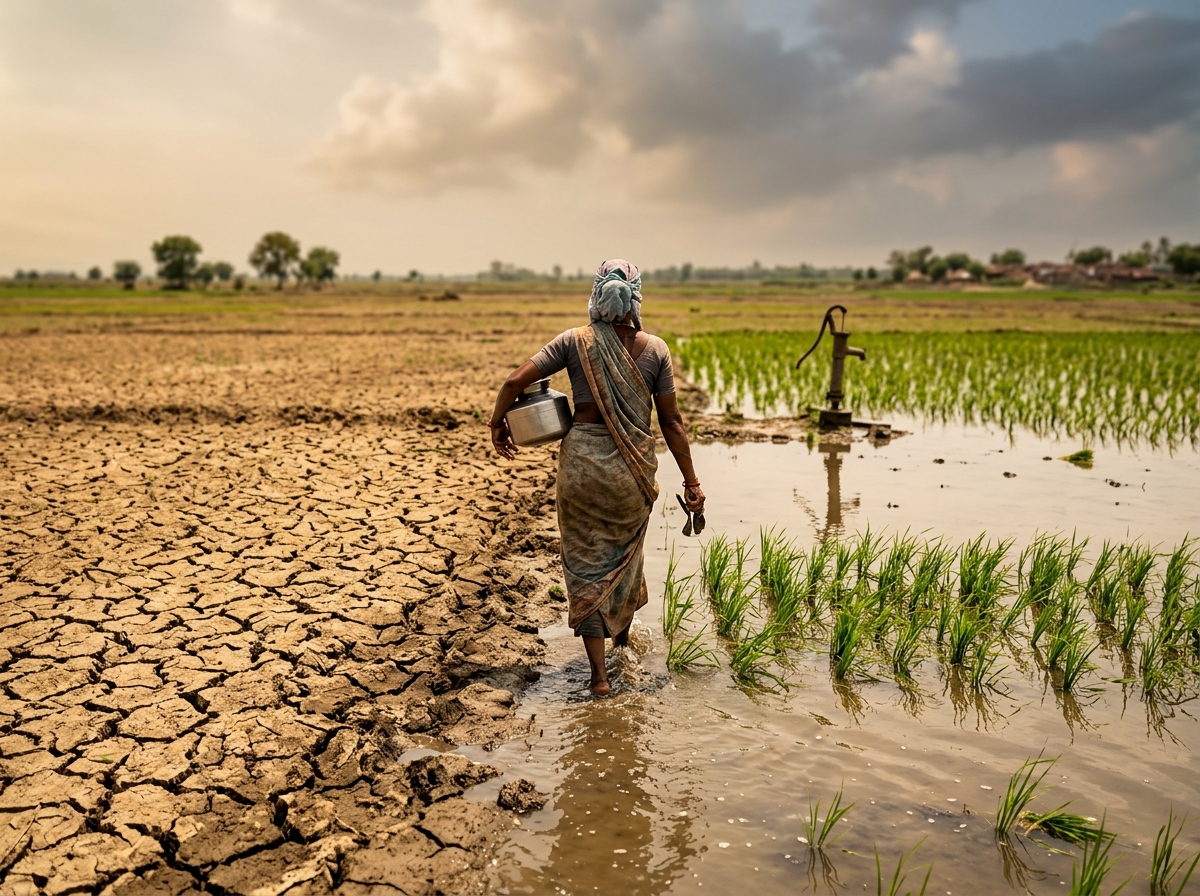
India's relationship with nature has always been unusually close. The monsoon determines when farmers sow. Rivers sustain enormous agricultural regions. Himalayan snow and glaciers contribute to major river systems. Groundwater supports farms when rainfall fails. Coastal waters sustain fishing communities, while forests and wetlands regulate water and provide livelihoods.
That dependence also makes India particularly exposed to environmental change.
Today, Indian agriculture increasingly faces a difficult combination: hotter temperatures + unpredictable monsoons + drought + extreme rainfall + flooding + groundwater depletion + air and water pollution + soil degradation.
These pressures do not operate independently. They reinforce one another.
India's latest climate reporting describes escalating flood and drought risks, increasingly unpredictable monsoon rainfall, more frequent wet and dry extremes, soil-moisture depletion and growing agricultural stress. *(UNFCCC)*
The challenge is therefore larger than simply "global warming." It is about protecting water, soil, crops, farmers, food supplies and rural communities in a climate that is becoming less predictable.
India Depends on Water — and Has Relatively Little of It
India supports roughly 18% of the world's population with only about 4% of global water resources, according to the World Bank.
Nearly 70% of India's rainfall occurs within just three months, and per-capita water availability has fallen by about half since 1970. The World Bank estimates that around 600 million people face water stress.
This creates an extraordinary paradox. India can experience *too little water* and *too much water* — sometimes in the same state and during the same year. A farmer may suffer drought early in the growing season and then lose the crop to flooding several weeks later.
The Monsoon Is India's Great Agricultural Engine
For centuries, farmers have organized agricultural life around the monsoon. The arrival of rain determines plowing · sowing · transplanting · irrigation · crop selection · harvest timing · livestock management.
But total seasonal rainfall tells only part of the story. For agriculture, when the rain falls can be as important as how much falls.
Imagine two years receiving approximately the same total rainfall.
Year One: Rain arrives gradually over several months. The soil absorbs it. Reservoirs refill. Crops receive water when needed.
Year Two: Weeks remain dry. Then enormous quantities of rain fall in two or three extreme events. Fields flood. Topsoil washes away. Crops become waterlogged. Much of the water runs rapidly into rivers and eventually the sea.
The annual rainfall totals might look similar. The agricultural consequences can be completely different.
Climate Change Is Making Water Management Harder
India's official climate reporting warns that changing precipitation patterns are producing more variable dry and wet spells, while rising temperatures intensify soil-moisture loss and drought stress.
This creates one of India's greatest climate-management challenges:
How do we capture water when there is too much and preserve it for periods when there is too little?
That question will increasingly shape Indian agriculture.
Extreme Heat and Crops
Plants have optimal temperature ranges just as humans and animals do. Extreme heat can interfere with germination · flowering · pollination · grain formation · fruit development · soil moisture · photosynthesis.
A few extremely hot days at a critical reproductive stage can cause substantial crop losses even if the rest of the growing season was favorable.
Wheat Is Particularly Sensitive to Heat
Northern India's wheat crop grows during the cooler rabi season. Unusually high temperatures late in the season can accelerate crop development and shorten the grain-filling period. The result: smaller grains + lower yields + reduced farmer income.
The Indian government's climate-agriculture assessment projects substantial future risks without adaptation. Modeling estimated potential wheat-yield reductions of about 19.3% by 2050 and 40% by 2080 under the scenarios studied. *(Press Information Bureau)*
These are projections rather than inevitable outcomes. Adaptation can substantially change the result.
Rice Faces a Different Set of Problems
Rice requires considerable water in many conventional production systems. It can therefore be affected by:
- Drought — insufficient water reduces growth.
- Extreme heat — high temperatures during flowering can reduce grain formation.
- Flooding — some varieties tolerate temporary flooding, but prolonged or deep submergence can destroy crops.
- Salinity — coastal agricultural areas may become increasingly exposed to saltwater.
India's climate-resilient agriculture assessment projected that without adaptation, rain-fed rice yields could decline about 20% by 2050 and 47% by 2080 under the modeled scenarios.
Again, these numbers illustrate the importance of adaptation rather than predicting an unavoidable future.
Drought: The Slow Disaster
A cyclone announces itself dramatically. A flood can transform a landscape overnight.
Drought is different. It develops quietly.
A farmer notices: *the rain didn't arrive.* Then: *the soil becomes dry.* Then: *the well falls.* Then: *the crop begins wilting.* Eventually an entire region may experience agricultural failure.
Agricultural Drought Is More Than Lack of Rain
Drought can involve:
- Meteorological drought — rainfall falls substantially below normal.
- Agricultural drought — soil moisture becomes insufficient for crops.
- Hydrological drought — reservoirs, rivers and groundwater decline.
These can occur at different times. A farmer may face agricultural drought even before reservoirs reach officially recognized drought conditions.
Higher Temperatures Make Drought Worse
Heat increases evaporation. Plants also lose water through transpiration. Therefore, the same rainfall deficit can become more damaging under hotter conditions.
Drought is not determined by rainfall alone. Temperature matters too.
Groundwater: India's Hidden Agricultural Bank Account
For decades, groundwater has protected Indian agriculture against unreliable rainfall. Millions of wells and borewells allow farmers to irrigate crops when the monsoon fails.
But this resilience has a cost. Groundwater can be withdrawn faster than nature replenishes it.
India is the world's largest groundwater user, and groundwater has historically supported more than 60% of irrigated agriculture.
Groundwater acts almost like a savings account. During bad rainfall years, farmers withdraw from it. But if withdrawals continually exceed recharge, eventually the account becomes depleted.
The Borewell Race
In some agricultural regions, declining groundwater creates a dangerous cycle:
Water table falls → farmer drills deeper → neighbor drills deeper → more pumping → water table falls farther → energy costs increase → small farmers become less competitive.
A wealthy farmer may afford a deeper borewell. A small farmer may not. Water scarcity can therefore become an economic inequality problem as well as an environmental one.
Punjab, Haryana and the Food-Security Paradox
The agricultural transformation of Punjab and Haryana helped India achieve enormous gains in food production. But intensive cultivation of water-demanding crops — particularly rice and wheat systems — has also placed heavy pressure on groundwater in parts of northwestern India.
The very regions that contributed enormously to national food security now face questions about the long-term sustainability of their agricultural model. Future solutions may require diversification toward crops better suited to local water availability.
Millet May Become Increasingly Important
India has a long tradition of cultivating bajra, jowar, ragi and other millets. Many millet varieties require substantially less water than irrigated rice and can tolerate difficult growing environments. They are also nutritionally valuable.
Climate adaptation may therefore involve not only developing new technologies but rediscovering crops Indian farmers cultivated for centuries.
Floods: The Opposite Agricultural Disaster
India's climate challenge is not simply drought. Floods are also increasing agricultural risk.
Floodwater can submerge crops · kill livestock · destroy stored grain · wash away seeds · erode topsoil · damage farm equipment · destroy roads · contaminate wells · damage irrigation systems.
Even after water recedes, farmers may be unable to plant because fields remain waterlogged.
Assam and the Brahmaputra
The Brahmaputra floodplain naturally experiences flooding. Floodwater can provide ecological benefits and replenish soils. The problem arises when extreme flooding intersects with dense settlement, agricultural expansion, infrastructure, riverbank erosion and land-use changes.
The distinction is important: flooding is a natural process. A flood disaster is partly about where and how people have built and farmed.
The severe 2026 Assam floods illustrate the continuing challenge: recent reporting described extensive displacement, livestock losses and submerged villages, with experts emphasizing better early warning, wetlands, floodplain restoration and long-term planning rather than relying only on reactive relief. *(AP News)*
Bihar and Eastern India
The Ganges basin and Himalayan tributaries create extensive fertile floodplains. These regions support enormous agricultural populations. But heavy monsoon rainfall upstream can produce devastating flooding downstream.
Climate adaptation therefore cannot stop at state boundaries. Rivers operate according to watersheds — not political borders. India increasingly needs river-basin planning involving multiple states and, in some cases, neighboring countries.
Flood and Drought Are Two Sides of the Same Problem
This may be one of the most important principles for India's future water policy. Instead of treating flood and drought as unrelated disasters, water should be managed across the entire cycle.
The World Bank similarly argues that India's increasing floods and droughts should be addressed as different ends of the same hydrological spectrum.
During periods of extreme rainfall: capture → slow → spread → recharge → store water wherever environmentally and economically practical. Then use those reserves during dry periods.
Restore Ponds and Traditional Water Systems
India once contained enormous networks of village ponds · tanks · stepwells · temple ponds · farm ponds · wetlands · small reservoirs.
Many traditional systems captured seasonal rainfall long before electric pumps and massive dams existed. Some have disappeared beneath roads, buildings, garbage and urban development.
Restoring appropriate traditional water systems could complement modern infrastructure.
Rainwater Harvesting
Imagine millions of homes + schools + factories + farms + apartment buildings capturing rainwater. Depending on local geology and water quality, harvested water can recharge groundwater · supply non-potable needs · reduce runoff · reduce pressure on municipal systems.
No single technology will solve India's water problem. Millions of small interventions can nevertheless produce significant cumulative benefits.
Pollution Adds Another Layer
Climate stress occurs alongside severe pollution problems. India must simultaneously address air pollution · water pollution · soil contamination · plastic waste · industrial pollution · agricultural chemical runoff.
These are not separate from food security. Pollution can directly affect agricultural productivity.
Air Pollution Can Damage Crops
Air pollution is often discussed mainly as a human-health issue. But plants breathe the same atmosphere.
Ground-level ozone can damage plant tissues and interfere with photosynthesis. The IPCC concludes with high confidence that surface ozone compromises crop yields. Research in India has similarly linked short-lived climate pollutants — including ozone and black carbon — with losses in wheat and rice production.
This creates a powerful opportunity: reducing certain air pollutants can benefit both human health and agriculture.
Crop-Residue Burning
Crop-residue burning illustrates how environmental problems become interconnected. Farmers sometimes need to clear fields rapidly between harvest and the next planting. Burning residue can be cheap and fast.
But widespread burning contributes to air pollution · particulate matter · greenhouse emissions · loss of organic material.
Simply blaming farmers does not solve the problem. Farmers need economically practical alternatives — including machinery, residue markets, composting, bioenergy and other uses that make crop residue valuable rather than burdensome.
Water Pollution and Agriculture
Polluted rivers and groundwater can affect irrigation and food production. Sources include untreated sewage · industrial discharge · fertilizer runoff · pesticides · solid waste.
When contaminated water is repeatedly used for irrigation, pollutants can accumulate in soil, crops and sediment. Water quality must therefore become as important as water quantity.
Fertilizers: Necessary but Easily Misused
Modern fertilizers helped India dramatically increase agricultural production. But excessive or poorly balanced fertilizer use can pollute groundwater · increase nutrient runoff · damage water bodies · increase nitrous oxide emissions · alter soil chemistry.
The solution is not simply "stop using fertilizer." It is: use the right nutrient, in the right quantity, at the right time and in the right place. Precision agriculture can help.
Soil Is India's Forgotten Climate Infrastructure
Healthy soil can hold water · nutrients · carbon.
Soil rich in organic matter can often absorb and retain more rainfall. Degraded soil may erode more easily · lose water rapidly · require more inputs · become less resilient to drought.
Protecting soil can therefore help farmers withstand both flood and drought.
Protect the Topsoil
Topsoil may take generations to develop. Extreme rainfall can remove it in hours.
Solutions include cover crops · mulching · contour farming · terracing · reduced tillage where suitable · agroforestry · vegetative buffer strips · check dams.
Keeping soil on the farm should become a central climate-resilience objective.
Trees Belong in the Agricultural Conversation
Agroforestry combines trees with crops or livestock. Trees can provide shade · fruit · fodder · timber · wind protection · carbon storage · habitat · soil stabilization. Their roots can reduce erosion and improve soil structure.
But species must be selected carefully for local conditions and water availability.
Climate Change Is Also Changing Pests
Warmer temperatures and altered rainfall can affect insect populations · plant diseases · weeds · fungal infections. Some pests may expand into regions where they previously could not survive.
Farmers therefore need rapid pest-observation and warning networks. This is an area where citizen environmental platforms could eventually contribute valuable observations.
India's Farmers Are Not All the Same
The phrase "Indian farmer" hides enormous diversity. India contains small subsistence farms · large commercial farms · rice paddies · tea plantations · coffee estates · coconut farms · apple orchards · wheat fields · millet farms · spice gardens · sugarcane fields · vegetable farms.
A climate solution appropriate for Punjab may be completely unsuitable for Kerala. A solution for Rajasthan may make little sense in Assam. India needs hyperlocal climate adaptation.
Kerala: Too Much Water and Too Little Water
Kerala demonstrates the complexity. The state receives substantial monsoon rainfall. Yet some areas can experience water shortages during the dry season. At other times, intense rainfall contributes to flooding · landslides · soil erosion · crop losses.
Kerala agriculture — including rubber, coconut, spices, banana, rice, vegetables, coffee and other crops — depends heavily on local rainfall patterns. Climate resilience must therefore focus on both drainage and water conservation.
Coastal Agriculture Faces Salinity
Sea-level rise and storm-driven saltwater intrusion can threaten agricultural areas near India's coastline. Salt can enter wells · rivers · soil · irrigation systems. Many crops cannot tolerate high salinity.
This creates particular concern for low-lying coastal and delta regions.
The Himalayas Matter to Indian Agriculture
The Himalayas are sometimes described as Asia's water tower. Snow and glaciers contribute to river systems that support enormous populations. Climate-driven changes to snowfall · glacier mass · seasonal melting can affect downstream water availability over time.
This connects Himalayan climate change directly to farms hundreds or thousands of kilometers away.
Farmers Need Better Weather Intelligence
A small farmer should ideally be able to receive a localized message such as:
> *Heavy rainfall likely in your area tomorrow afternoon. Delay fertilizer application and prepare drainage.*
Or:
> *High nighttime temperatures expected during flowering. Irrigate according to local agricultural guidance.*
Or:
> *Brown planthopper observations increasing within 20 km of your farm. Inspect your rice crop.*
Climate adaptation becomes much more useful when information reaches the farmer as an action, not simply a weather forecast.
Crop Insurance Must Evolve
When weather becomes less predictable, agricultural insurance becomes increasingly important. Insurance systems need reliable evidence about rainfall · drought · flooding · hail · heat · crop damage.
Satellite observations, weather stations, farm records and GPS-tagged field observations could eventually make claims faster and more transparent.
India Needs Millions of Local Environmental Observers
Government weather stations and satellites provide extraordinary information. But India contains more than 600,000 villages.
A satellite can measure vegetation. It cannot always tell us: *"Mango flowering started three weeks early in our village."*
A weather station can measure temperature. It may not record: *"Our village pond dried up for the first time anyone remembers."*
A rainfall gauge records rain. It cannot necessarily tell us: *"The rice field remained underwater for nine days."*
These local observations matter.
The Opportunity for NaturePulse
This is where NaturePulse could eventually make a meaningful contribution. Imagine farmers, students, teachers, environmental organizations and ordinary citizens documenting:
rainfall · drought · flooding · crop condition · flowering · fruit formation · harvest dates · pests · water levels · tree health · wildlife · soil erosion · landslides · coastal changes.
Every observation can carry GPS + Date + Time + Photograph + Description + Category.
A Living Agricultural Climate Map of India
NaturePulse could eventually display mango flowering observations · rice planting dates · coconut disease reports · wells drying · village pond levels · flooded agricultural fields · pollinator observations · pest outbreaks · unusual rainfall · heat damage — on maps organized by Village → District → State → India.
Over time, patterns may emerge.
One Observation Means Little. Millions Can Mean Something.
Imagine a farmer in Kerala records: *Jackfruit flowering unusually early — February 12.* Another farmer records the same. Then 100. Then 10,000 observations appear across South India.
Researchers could compare those citizen observations with temperature · rainfall · historical flowering periods · satellite vegetation data.
That could become useful phenological evidence of environmental change.
NaturePulse should not replace professional scientific monitoring. It can add another observational layer to it.
India Can Also Become a Climate-Adaptation Leader
India's enormous scale makes its environmental challenges intimidating. But scale also creates opportunity. A successful Indian solution can affect hundreds of millions of people.
India has capabilities in satellite technology · digital infrastructure · agricultural science · weather forecasting · renewable energy · information technology · artificial intelligence · mobile communications.
The country also possesses thousands of years of accumulated agricultural knowledge.
The future does not have to be *traditional knowledge OR modern technology.* It can be Traditional Knowledge + Science + Technology + Community Observation.
The Farmers Must Be at the Center
Climate policy can easily become a conversation among governments, scientists, corporations and international institutions. But ultimately a farmer has to decide:
*What do I plant? When do I plant? Will the rain come? Is there enough water? Can I afford irrigation? Will the crop survive the heat? Will flooding destroy it? Can I sell it for enough to support my family?*
Climate adaptation succeeds only when it helps answer those questions.
India's Climate Challenge Is Also Humanity's Challenge
India is home to more than a billion people and is one of the world's great food-producing nations. What happens to Indian agriculture therefore matters beyond India's borders.
Climate change, pollution, drought and flooding threaten to make food production increasingly unpredictable. The IPCC warns more broadly that droughts, floods and other climate extremes are already reducing food availability and threatening livelihoods and food security, particularly among small-scale producers and vulnerable communities.
But India's future is not predetermined.
- Water can be conserved.
- Groundwater can be recharged.
- Soils can be restored.
- Wetlands can be protected.
- Crops can be diversified.
- Heat- and drought-tolerant varieties can be developed.
- Pollution can be reduced.
- Farmers can receive better forecasts.
- Flood warnings can improve.
- Traditional water systems can be restored.
- And millions of people can participate in observing what is changing around them.
NaturePulse.net — Observe · Document · Understand · Adapt
A changing monsoon should be recorded.
A drying well should be recorded.
A flooded field should be recorded.
An early flowering tree should be recorded.
A disappearing pond should be recorded.
A farmer's experience should be recorded.
India's environmental transformation is occurring village by village, farm by farm and season by season.
If those observations are systematically preserved, shared responsibly and connected with scientific data, they can help future generations understand not only that India's climate changed — but how, where, when and what people did about it.