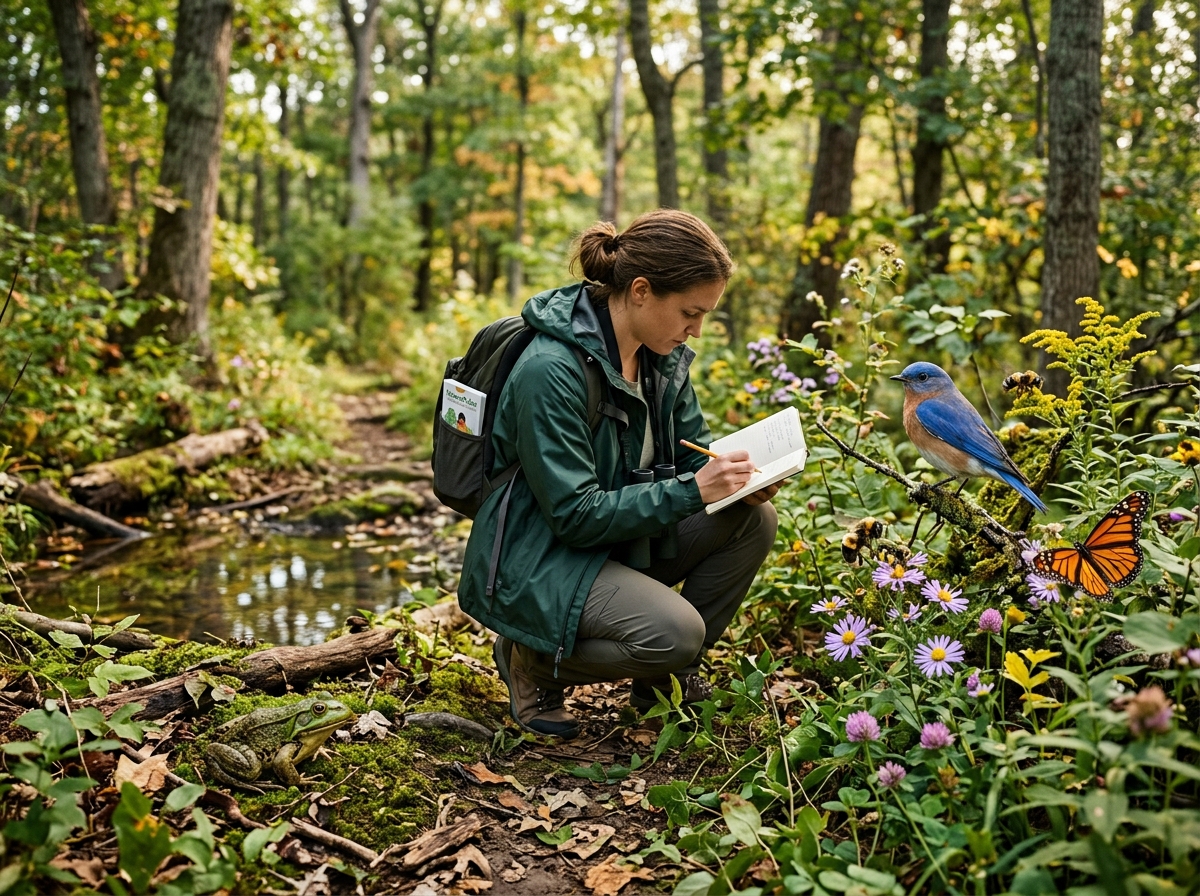
A healthy place often reveals itself through patterns. No single observation proves that an ecosystem is healthy, but when many indicators point in the same direction, they tell a powerful story.
This is a field guide to the signals — the small, everyday clues in your neighborhood, garden, park, stream or forest edge that together reveal whether nature is thriving, stressed or in the middle of quiet change. Each one is something you can photograph, record and revisit on NaturePulse.
Birds
Track not just the number of birds, but the variety of species. A neighborhood with insect-eating birds, seed-eaters, nectar feeders, ground birds and seasonal migrants may indicate a more diverse habitat than one dominated by only a few highly adaptable urban species.
Useful observations include species count · nesting · chicks · migration timing · feeding behavior · disappearance of previously common birds · arrival of new species.
Insects & Pollinators
Bees, butterflies, moths, dragonflies, beetles and other insects are excellent environmental indicators. A healthy neighborhood should support pollinators at different times of year. A sudden decline may suggest loss of flowering plants, pesticide exposure, drought or habitat change.
Observe bee activity · butterfly diversity · first seasonal appearance · flowers visited · dragonflies near water · unusual pest outbreaks.
Frogs and Amphibians
Frogs, toads and salamanders are especially valuable because their permeable skin makes them sensitive to water quality and environmental contamination.
Hearing frogs after rain, finding tadpoles and observing multiple amphibian species can indicate functioning wetlands or ponds. A disappearance can be worth documenting.
Bats
Bats are important insect predators and pollinators in many regions. Regular evening bat activity may indicate a healthy supply of insects and suitable roosting habitat.
Record: approximate number · time of emergence · feeding areas · seasonal presence · disappearance.
Earthworms and Soil Life
A neighborhood can look green while the soil beneath it is degraded. Healthy soil often contains earthworms, insects, fungi and decomposing organic material.
Observe earthworms after rain · soil texture · moisture · organic matter · fungal growth · leaf decomposition — and whether soil is hard, compacted or lifeless.
Wildflowers and Native Plants
Plant diversity is another major indicator. A landscape containing different layers — ground plants, shrubs, small trees and mature trees — usually provides more habitat than a landscape consisting almost entirely of lawn.
Observe number of flowering species · native species · invasive plants · flowering periods · fruiting · seed production · plant regeneration.
Tree Health
Trees can reveal years of environmental stress. Look for healthy canopy growth · new leaves · flowering · fruiting · nesting · bark condition · fungal disease · insect damage · premature leaf drop · dead branches.
One particularly useful NaturePulse idea would be to follow the same trees every year.
Natural Tree Regeneration
A healthy woodland should not contain only old trees. Look for seedlings and young trees beneath mature trees.
If mature trees remain but no young trees are appearing, future forest health may be at risk.
Lichens
Lichens growing on tree trunks, rocks and walls can be useful indicators of environmental conditions, particularly air quality.
Different lichen species have different sensitivities to pollutants, so long-term changes in lichen abundance can be informative.
Mushrooms and Fungi
Fungi are essential decomposers and partners of many plants. Regular mushrooms and other fungi in suitable habitats can indicate active soil ecology, moisture and organic matter.
They should be observed, not eaten unless independently identified as safe.
Streams and Creeks
A stream tells an enormous story. Observe clear or cloudy water · odor · algae · trash · foam · aquatic insects · fish · frogs · water level · seasonal flow · erosion.
A stream containing diverse aquatic insects and other life is generally more encouraging than one with stagnant water and little visible life.
Dragonflies
Dragonflies are especially interesting because their larvae live in water while adults live above it. Their presence links aquatic health with surrounding terrestrial habitat. They could become a dedicated NaturePulse indicator.
Fish and Aquatic Life
In ponds, rivers and lakes, observe fish · snails · insects · aquatic plants · amphibians. Sudden fish deaths should be documented because they can indicate low oxygen, pollution, extreme heat or other disturbances.
Water Clarity
Track how clear local water is at the same place over time. After heavy rain, temporary turbidity may be normal. Persistent changes can indicate erosion, runoff or pollution.
Seasonal Water Levels
A pond that always held water but now dries each summer is telling you something. So is a stream flowing longer into the dry season. Record the same waterbody repeatedly with GPS and photographs.
Butterflies
Butterflies are excellent public-facing indicators because people enjoy observing them and many species have strong associations with particular host plants.
Record both adult butterflies and the plants on which eggs or caterpillars are found.
Caterpillars
Caterpillars are sometimes treated only as garden pests, but they are a critical food source for many birds.
A neighborhood with plenty of birds but almost no insects may eventually struggle to support breeding populations.
Bees
Instead of simply asking *"are there bees?"*, NaturePulse can ask how many kinds?
Honey bees alone do not represent complete pollinator diversity. Bumblebees, solitary bees and other native pollinators matter greatly.
Ants
Even common ants can indicate soil activity and food-web complexity. Sudden changes in dominant ant species may also reveal invasive species or habitat disturbance.
Spiders
Spiders are predators of insects and can reflect the availability of prey and habitat complexity. They are another useful sign that the food web is functioning.
Moss
Moss can reveal shaded, moist microhabitats and surface conditions. Its presence or disappearance can reflect changes in moisture, canopy cover or disturbance.
Leaf Litter
A perfectly cleaned landscape may look neat but provide little habitat. Leaf litter supports insects, fungi, soil organisms and overwintering wildlife.
Observe whether natural areas retain organic material and whether it decomposes normally.
Dead Wood
A fallen log is not necessarily waste. Dead wood can support beetles · fungi · birds · other organisms. A healthy forest often contains some standing and fallen dead wood.
Bird Nests
Nesting may be more meaningful than merely seeing birds passing through. Record nesting location · species if known · eggs/chicks only from a safe distance · dates.
Never disturb nests for photographs.
Pollinator Nesting Sites
Healthy habitat also includes places for reproduction. Look for hollow stems · bare soil areas used by ground-nesting bees · other natural nesting sites.
Seeds and Fruits
Plants producing flowers but no fruit can sometimes indicate inadequate pollination or environmental stress.
Track: Flowering → Pollination → Fruit → Seed. This would be extremely useful on NaturePulse.
Wildlife Breeding
Young animals are evidence that habitat is doing more than temporarily attracting adults. Observe fledgling birds · tadpoles · young mammals · other signs of reproduction — without disturbing them.
Predators
A functioning ecosystem contains predators as well as prey. Hawks, owls, foxes, snakes and other predators can indicate a more complete food web.
Their presence should not automatically be interpreted as a problem.
Scavengers
Vultures, crows and other scavengers play essential roles in removing dead material and recycling nutrients. Their abundance or decline can also be environmentally informative.
Native vs. Invasive Species
A neighborhood may contain lots of vegetation but still have declining ecological quality if a few invasive species dominate. NaturePulse should distinguish species abundance from species diversity and ecological value.
Flowering Throughout the Year
A healthy pollinator environment ideally offers food across multiple seasons. Record which plants bloom in spring · summer · fall · winter, depending on climate.
Long gaps without flowers can limit pollinator populations.
Nighttime Nature
Nature does not stop at sunset. Observe bats · moths · frogs · owls · fireflies · nocturnal insects.
Excessive artificial light may change these communities.
Fireflies
In places where fireflies naturally occur, their abundance can be a particularly engaging indicator. Declines may relate to habitat loss, pesticides, artificial lighting or other factors.
Noise
A healthy neighborhood is not defined by silence, but excessive traffic, aircraft or industrial noise can affect birds and wildlife.
NaturePulse could allow users to record a simple quiet / moderate / loud observation — or actual sound levels where available.
Artificial Light at Night
Street lighting and building illumination can affect insects · birds · turtles · bats · human circadian rhythms.
Photographing the same night sky could also document increasing or decreasing light pollution.
Stars
This is a surprisingly simple indicator of artificial light pollution. Ask users: how many stars can you see tonight?
Not a scientific measurement by itself, but repeated observations can engage the public.
Air Clarity
Can distant hills usually be seen? Are they disappearing behind haze? Users can document visibility from the same GPS viewpoint. This can complement formal air-quality measurements.
Tree Leaves as Pollution Indicators
Dust, soot or visible deposits on leaves near busy roads or industry may be worth recording — though NaturePulse should avoid attributing a cause without evidence.
Smell
People often notice environmental change first through smell. Examples: sewage · smoke · chemicals · algal bloom · clean earthy smell after rain.
Allow observations, while clearly distinguishing them from verified pollution findings.
Algae
A sudden algal bloom in a pond or lake can signal changing nutrient, temperature or water conditions. Record color · extent · odor · associated fish mortality.
Wetlands
Healthy wetlands may support frogs · dragonflies · waterbirds · aquatic plants · fish. Track both biodiversity and water extent.
Floodplain Activity
Periodic flooding can be natural and beneficial. What matters is whether the system has room to flood safely and recover. Observe changes in wetlands · vegetation · sediment after floods.
Springs
Natural springs are excellent long-term indicators. Record whether a spring flows year-round · becomes seasonal · has changed volume · has changed clarity.
Older residents' memories can add valuable historical context.
Groundwater Wells
Where appropriate and privacy-safe, communities can record non-sensitive well-water levels over time. A neighborhood where wells steadily deepen may be telling an important water story.
Seasonal First-Signs (the Annual Almanac)
- First rain of the season — record every year. Compare date + amount + vegetation response + insect response + frog activity.
- First flower — choose common local plants and record the first flowering date annually.
- First fruit — likewise, record first ripe fruit.
- First migratory bird — this can become an especially valuable annual observation.
- First frost / first snow — important in colder climates.
- Last frost — agriculturally very valuable.
- Autumn leaf change — track the same tree annually.
- Leaf drop — likewise.
Heat and Drought Stress
Look for wilting plants · leaf scorch · dry ponds · wildlife seeking water. Document without overstating causality.
Drought indicators include early leaf drop · dry streams · cracked soil · poor fruit development · reduced flowering.
Recovery After Rain
A healthy ecosystem often responds quickly. Photograph vegetation during drought and two weeks after rain.
Roadkill and Wildlife Corridors
Sadly, wildlife killed on roads can tell us where animals are crossing. Aggregated observations might identify important wildlife corridors, while exact locations for sensitive species should be handled carefully.
Wildlife Corridors
If animals repeatedly cross the same area, that location may connect habitats. Document tracks and sightings.
Animal Tracks
Not every observation requires seeing the animal. Tracks · droppings · feathers · nests · feeding signs can all document wildlife presence.
Native Seedlings
Natural seedlings under mature plants are signs of reproduction and ecosystem continuity.
Bee-to-Flower Ratio
NaturePulse could eventually create simple indicators:
- Many flowers + many pollinators = encouraging
- Many flowers + almost no insects = worth watching
Not a scientific diagnosis, but a useful observation trigger.
A NaturePulse "Neighborhood Health" Dashboard
Eventually, these observations could become a carefully designed NaturePulse Neighborhood Nature Index — but we would avoid giving one simplistic score at first.
Instead show a dashboard, each with High / Moderate / Low / Insufficient Data:
- Bird diversity
- Pollinator activity
- Native plant diversity
- Tree canopy & tree health
- Soil life
- Water health
- Amphibian activity
- Seasonal stability
- Artificial light
- Noise
- Air & visibility
- Invasive species pressure
- Habitat connectivity
Most importantly, show: *Based on community observations — not a formal environmental certification.*
That protects the scientific integrity of the platform.
What Is Nature Telling You?
Don't just look for something beautiful. Look for patterns.
Are there more birds or fewer? Are bees visiting the flowers? Are frogs still calling after the rains? Is the stream flowing? Are young trees replacing old ones? Are butterflies arriving at the same time each year?
Nature is constantly giving us signals. NaturePulse helps us notice, record and remember them.
That could become one of the core philosophies of NaturePulse: not simply documenting nature, but learning to read it.